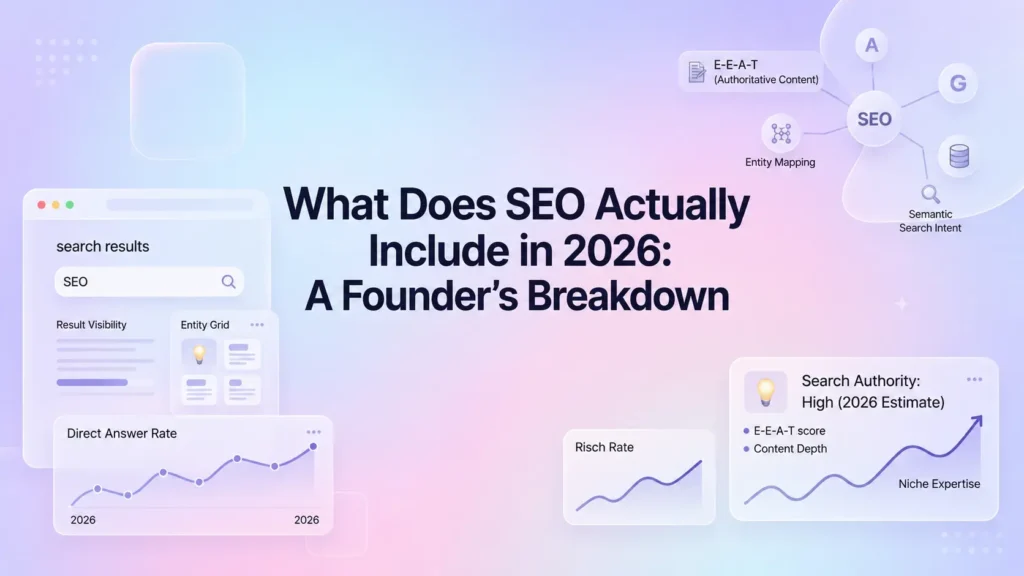
In 2026, SEO includes six components: technical SEO (site structure, page loading speed, indexing), on-page SEO (content, keywords, formatting), content strategy (topical authority, pillar-cluster architecture), off-page SEO (backlinks, brand authority), AI search optimisation (AEO, GEO, LLM visibility), and analytics. Most founders try to do all six simultaneously. However, the right approach is to be sequential and strategic, i.e., technical foundation first, then content, then authority building, and finally the AI visibility layer.
How has SEO transformed in 2026
The fundamentals of SEO are still the same as they were 5 years ago. The textbook definition still means ‘optimizing websites for search engines.’ What have changed now are the requirements and the factors underlying optimization.
The real questions founders are asking today are “How has SEO changed in 2026?”, “What does it include?”, and “Which parts apply to me right now?”
Because of the lack of answers to these fundamental questions, most founders either do too little, like publishing a few posts and waiting, or try to do everything at once and execute nothing well.
In this post, I’ll be sharing a component-by-component breakdown with honest priority ratings for early-stage founders.
Read about modern SEO strategies here.
Component 1 – Technical SEO (The Foundation of Any Website)
Technical SEO is the process of ensuring that search engines or bots can crawl, index, and understand your website’s important pages. This also includes ensuring fast page loading speeds and mobile responsiveness, both of which are now covered under Google’s Helpful Content system. In the absence of technical SEO, content and backlinks underperform regardless of quality.
What does technical SEO include?
- Indexing: Are your pages being discovered and stored by Google? (GSC page indexing report)
- Crawlability: Ensuring no important pages are blocked by robots.txt or noindex tags
- Site speed and Core Web Vitals: LCP, CLS, INP – part of Google’s page experience signals
- Mobile-first rendering: Google indexes the mobile version first
- Site architecture: Logical URL structure, no orphaned pages, clean internal linking
- Schema markup: Structured data that helps Google categorise content types
The SaaS-specific issues most guides miss include a blog hosted on a subdomain instead of a root domain, JavaScript rendering problems on React/Next.js sites, and duplicate content from app subdomains. (Read about SaaS SEO Roadmap for Founders – Priority Checklist.)
Founder priority rating: High – fix this before anything else.
Component 2 – On-Page SEO (Content directly under your control)
On-page SEO refers to the process of optimising individual pages to match the search intent of users looking for specific solutions or products. This covers content optimization, page structure, keyword placement, formatting signals, etc.
What does on-page SEO include?
- Title tags: primary keyword + modifier + brand (under 60 characters)
- Meta descriptions: don’t affect rankings directly but significantly affect CTR
- Header structure: H1 is the main topic, H2s are subtopics. One unique H1 per page
- Keyword placement: in title, first 150 words of the content, at least one H2, naturally throughout
- Content depth: does the page comprehensively answer the search query?
- Internal linking: connecting pages within your site to distribute authority and help Google understand content relationships
- The 2026 addition (passage-level formatting): Google and AI engines increasingly extract individual sections rather than ranking whole pages. Every H2 section should answer its implied question completely, without requiring context from surrounding sections.
Founder priority rating: High – applies to every page you publish
Component 3 – Content Strategy (The System Behind the Posts)
Content strategy in SEO is the planning layer that determines what to publish, in what order, and how content pieces interconnect so they build topical authority rather than existing as standalone pages.
What content strategy includes:
- Keyword research: Understanding the search intent of your audience before writing anything — intent first, volume second
- Funnel mapping: BOFU (comparison, alternatives, pricing) → MOFU (problem-aware guides) → TOFU (educational content) in the same publishing order
- Pillar and cluster architecture: One comprehensive pillar post supported by 5–8 cluster posts, all internally linked – this is how topical authority is built
- Content briefs: A documented plan for every post covering target keyword, intent, recommended structure, competing URLs, word count, and internal links
- Content refresh: Updating existing posts with new data, better structure, and improved internal linking – this often provides a higher ROI than publishing new content
Founder priority rating: High – It is the system that makes individual posts compound
Component 4 – Off-Page SEO (Building Authority for Your Site)
Off-page SEO covers everything that happens outside your website that signals to Google that your content is trustworthy and authoritative. This is built primarily on high-quality backlinks, brand mentions, and entity signals.
What off-page SEO includes:
- Backlinks: Links from other authoritative websites to yours – quality and relevance matter far more than quantity in 2026
- Link-building methods that work: Digital PR, guest posts on relevant publications, partnerships, and original research that earns citations passively
- Link-building methods that have become obsolete: Bulk directory submissions, paid link networks, irrelevant guest posts
- Brand mentions: Unlinked citations of your brand name across the web – Google increasingly treats these as authority signals even without a hyperlink
- E-E-A-T signals: Experience, Expertise, Authoritativeness, and Trustworthiness – Google’s framework for evaluating content credibility. In 2026, this means named authors with verifiable expertise, first-hand experience demonstrated in content, and editorial consistency
As a founder, don’t prioritise link building until you have at least 10–15 solid pieces of content worth linking to. Build the content foundation first, then pursue authority signals.
Component 5 – AI Search Optimisation (The New Age SEO)
AI search optimisation is the practice of structuring your web content and building brand authority so it gets cited in AI-generated answers from Google AI Overview and answer engines like ChatGPT and Perplexity and not just in traditional blue links.
What AI search optimization includes:
- Answer Engine Optimisation (AEO): formatting content for AI extraction – direct answers blocks early, self-contained, structured H2 sections, FAQ schema, declarative language
- Generative Engine Optimisation (GEO): building entity authority so your brand gets cited in AI answers, supported by consistent brand signals, editorial mentions, G2/Capterra presence
- LLM visibility: manually tracking whether your brand or content appears in ChatGPT and Perplexity results for your core keywords or prompts
Nearly 60% of Google searches already end without a click to any website. BOFU and comparison content are largely AI-resistant; i.e., AI engines link out to the websites rather than summarise when someone is ready to buy. TOFU and MOFU content faces the biggest risk. The founders who successfully dominate AI search are those who structure content for extraction from day one.
Founder priority rating: Medium now, High within 12 months
Component 6 – Analytics and Measurement (Monitoring the Website Performance)
Setting up SEO analytics is the tracking system that tells you which pages on the website are being discovered and indexed, which queries are driving traffic, and whether organic search is contributing to revenue, not just impressions.
What does it cover?
- Google Search Console: impressions, clicks, average position, indexing status, Core Web Vitals
- GA4: organic traffic sessions, pages per session, conversion events tied to organic source
- Keyword rank tracking: monitoring position changes for target keywords (Ahrefs, Semrush)
- Conversion attribution: connecting organic sessions to trial signups, form fills, or purchases in your CRM
Start by monitoring only 5 metrics monthly
- Total indexed pages (GSC)
- Clicks and impressions (GSC)
- Keywords in top 10 (Ahrefs/Semrush)
- Organic signups or leads (GA4 + CRM)
- Top 3 ranking pages, and their alignment with the pages you want to target
Founder priority rating: High from Day 1 – set the tools and conversion tracking up before publishing anything
What SEO Does NOT Include in 2026
A few concepts in SEO have become obsolete and are not worth paying attention to. A few of the outdated concepts in SEO include the following:
- Keyword stuffing: stopped working in 2015. Keyword placement has become more about relevance, not density
- Buying backlinks: Might provide short-term rankings, but long-term penalty risk. Not worth it at any stage
- Publishing AI-generated content without editing: Google’s Helpful Content system is particularly designed to detect and demote undifferentiated AI output. Use AI for research and outlines, but not as a publishing pipeline or your content might come under ‘scaled content abuse’ penalty
- Chasing domain authority: Most startups or founders chase this metric, which is invented by Moz, not Google. It’s not a primary metric to track and builds over time
- Social media follower counts: social signals do not directly influence Google rankings. Distribution helps content get links, but follower counts themselves mean nothing to the algorithm
- Gaming AI Overviews with tricks: There is no shortcut to AI citation. Structured content, genuine expertise, and consistent brand signals are the only reliable path
The Priority Order for Founders
- Technical foundation first – indexing, GSC setup, Core Web Vitals, root domain blog
- Analytics setup – before publishing a single post
- 10 BOFU keywords – before writing anything
- On-page optimisation – applied to every piece of content from post one
- Content strategy – pillar and cluster architecture, publishing in funnel order
- AI search layer – FAQ schema, passage-level formatting, entity signals
- Off-page authority – once you have content worth linking to
Read about the priority order of SEO activities for founders or initial-stage founders.
Frequently Asked Questions
Q. What is the difference between On-Page and Off-Page SEO?
A. On-page SEO is everything on the website within your control – title tags, headers, content, internal linking, and schema markup. Off-page SEO is everything outside it, such as backlinks, brand mentions, and editorial citations. Both contribute to your organic visibility, but the sequence is fixed: always optimise on-page first. There’s no point building backlinks to a page that isn’t properly set up for its target keyword.
Q. Does technical SEO matter more than content SEO?
A. Neither works without the other, but technical SEO comes first. A well-written post on a site with indexing issues or a blog on a subdomain will consistently underperform a decent post on a technically clean site. Always fix the technical foundation first, then build content on top of it.
Q. What is AEO, and how is it different from SEO?
A. SEO means ranking in Google’s traditional blue links on the Search Engine Result Page (SERP). AEO (Answer Engine Optimization), on the other hand, earns a citation or reference in AI-generated answers such as Google AI Overview, ChatGPT, and Perplexity. In 2026 you need both. Traditional rankings drive clicks, while AI citations bring brand visibility before a user ever visits your site.
Q. What is E-E-A-T, and does it matter for startups?
A. E-E-A-T is an SEO principle that stands for Experience, Expertise, Authoritativeness, and Trustworthiness. It is Google’s framework for evaluating content credibility. For startups, it generally means named authors with real credentials; first-hand experience demonstrated in content (real examples, case studies, and original data); and consistent brand signals across your site and third-party platforms.

Rahul Bajaj is an SEO strategy consultant with 6+ years of experience helping SaaS companies, startups, and enterprise brands grow organic revenue. He has worked across industries including cybersecurity, medical, automotive, SaaS, real estate, ed-tech, and sustainability brands, delivering 170%+ organic monthly traffic growth, 200%+ YoY organic growth, and 120+ AI visibility snippet wins for his clients. His expertise includes technical SEO, search-intent-driven content strategy, and AI search optimization. He writes on SEO strategy, digital marketing careers, and organic growth at Grow Digital Career.