A few weeks ago, I typed “best free/paid digital marketing courses in 2026” into ChatGPT.
To my surprise, I found my own blog showing up in the answer, and that too in multiple instances.
(snapshot below)
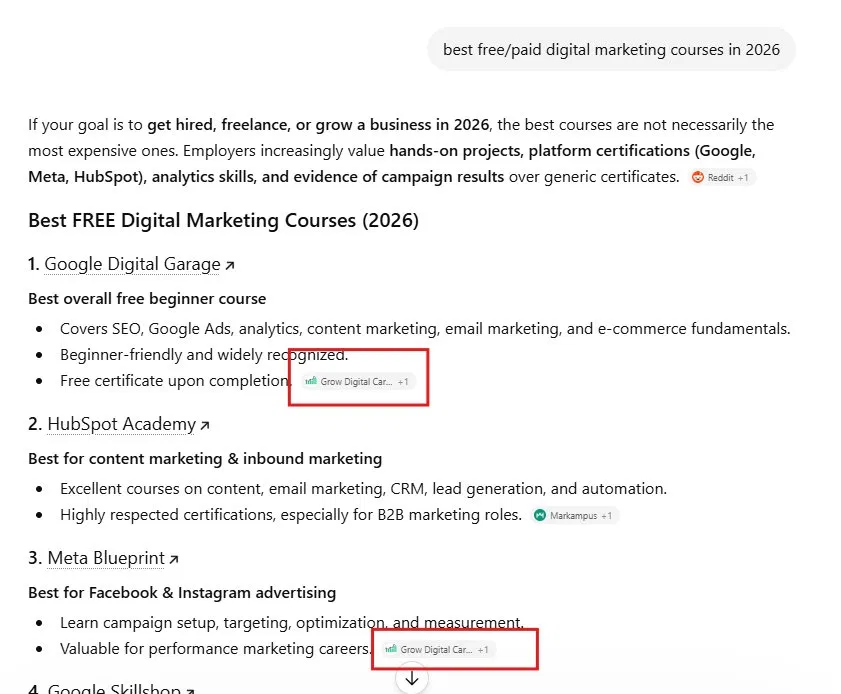
To provide some context, I didn’t build any high-quality backlinks, and the blog was relatively new, yet it started getting cited within one week of publishing. The only thing I did right was write content the right way.
And that’s exactly what this post is about.
I’ll break down the specific things I did on my blog that I believe led to this. Besides, I’ll also show you which platforms cite content most aggressively and how you should be approaching the entire thing.
So, if you’re an SEO, founder, or marketer trying to show up in AI search, here’s what actually worked for me.
What It Means to Be “Referenced” by AI Search
AI search is a broad domain, and there are different ways your brand can be referenced in AI-generated responses on LLM tools such as ChatGPT, Perplexity, and Gemini. A few ways your content might get cited on these platforms are listed below
Cited as a Source
Answer engines like ChatGPT pull answers from live URLs and show your domain as a referenced source while generating responses to user prompts.
Mentioned by Brand Name
Here, you don’t get cited directly from your own domain or live URLs in AI-generated responses. Instead, AI recognizes your brand as an authority based on mentions across the web, including forums, Reddit, LinkedIn, third-party articles, and more.
This is essentially entity recognition, where your brand gets referenced because multiple authoritative websites and sources mention it.
Paraphrased Without Attribution
This is the most common yet hardest-to-track scenario. In this case, your content shapes the answer, but your brand name never appears as the referenced source.
In my case, GrowDigitalCareer.com was cited as a source and mentioned in the response body for a query I hadn’t specifically optimized for. However, this didn’t happen accidentally. There’s an entire strategy that I believe led to it.
How I Tracked That My Content Was Being Referenced
While writing this blog, I had a very clear understanding of my target audience’s pain points, i.e., students exploring digital marketing courses in 2026, and hence optimized my content accordingly.
I didn’t rely on any fancy tools or paid monitoring software to track citations. Most of the process involved deliberate manual testing across different environments, such as incognito mode, different prompt variations, and separate sessions.
A few days after publishing the blog post, I started typing variations of the queries my blog covered directly into platforms like ChatGPT, Perplexity, and Gemini.
It went beyond targeting the primary keyword and focused more on how users would naturally phrase prompts, such as:
- “What are the best free digital marketing courses in India?”
- “Which digital marketing course should a fresher do in 2026?”
- “Is Google Digital Garage worth it?”
That’s when I found GrowDigitalCareer getting cited in multiple responses.
So, if you’re just starting out, manual prompt testing across ChatGPT, Perplexity, and Gemini is enough to determine whether your content is being picked up.
The 6 Things I Did That I Believe Led to the Citation
1. Structured Content for Extraction, Not Just Ranking
Every blog I publish on Grow Digital Career follows a consistent pattern: direct answer first, context second, and details third.
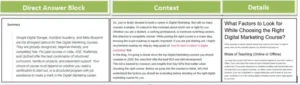
For AI citations, it’s important not to beat around the bush. Be very specific about the questions or pain points you’re trying to address.
In my case, the objective was to help students and professionals identify quality digital marketing courses.
2. Built Topical Authority Across Multiple Blog Posts
I didn’t focus on creating a single blog post. Instead, I supported it with several interrelated cluster-content pieces that students and professionals are likely to search for.
I wrote on topics such as the following:
- Digital marketing skills
- Learning SEO
- Roadmaps for starting a career in digital marketing
- Career opportunities in digital marketing
This helped establish topical authority around the subject rather than relying on a single page to rank and get cited.
3. Clear Hierarchy and Structure
I paid close attention to making my content well-structured and easy to read.
Some of the things I consistently implemented included:
- A table of contents
- Proper heading hierarchy
- Relevant subheadings
- Bullet points where required
- Tables for easier parsing
- FAQ sections to address common questions
Additionally, I implemented structured data such as FAQ schema and How-To schema to improve relevance and make the content easier for search engines and LLMs to interpret.
This helped LLMs gain the right context and better understand the content.
Read Google’s documentation on structured data
4. EEAT Signals
I try my best to support every blog post with my personal experience of working in this industry for more than six years.
All my blogs include an author profile where I position myself as an SEO consultant who has worked across multiple industries helping brands scale their organic growth.
This reinforces credibility and builds trust, not only among readers but also among search engines and AI systems.
Read Google’s documentation on EEAT
5. Strong Interlinking
When I say “interlinking,” I don’t just mean linking to related internal blog posts.
I also use outbound links whenever they add value.
My primary objective has always been to make the content genuinely useful. If I feel readers may benefit from additional information available elsewhere, I don’t hesitate to link out.
For this particular blog, I focused heavily on linking to external course pages from institutes and platforms such as Google Digital Garage, IIDE, and HubSpot Academy.
6. Intent Mapping Over Keywords
This might sound surprising to many, but I didn’t keep a single keyword in mind while writing this post.
In fact, I didn’t conduct any keyword research for it.
My only objective was to create content that would help students and professionals make informed decisions when choosing the right digital marketing course for their needs.
I focused on satisfying search intent and addressing genuine pain points rather than targeting specific keywords and forcing them into the content.
Platform-by-Platform Breakdown
The interesting part is that when you optimize content to be cited by LLM platforms and answer engines, you’ll notice that each platform references websites differently.
Getting featured on ChatGPT doesn’t automatically mean you’ll get cited on Perplexity or Gemini.
Once I saw my blog cited on one platform, I started testing the same queries across multiple AI tools to identify patterns.
Here’s what I observed:
| Platform | Citation Behavior | What Helped Most |
| ChatGPT (with Browse) | Cites sources in live search mode | Fresh dated content, concise direct answers |
| Perplexity | Most aggressive citation | Factual claims with clear sourcing |
| Gemini | Brand mentions over direct citation | Entity presence, Google ecosystem signals |
| AI Overviews (Google) | Pulls from top-ranked content | Traditional SEO + structured data |
Conclusion
If I had to sum up my experience, I would say that getting cited by AI tools is not rocket science, and the fundamentals of SEO still remain intact. If you’re creating content that answers real questions, structuring it properly for easy extraction, staying consistent within a specific topic or niche, and, most importantly, addressing the intent of your target audience, the likelihood of being cited by these platforms increases significantly.

Rahul Bajaj is an SEO strategy consultant with 6+ years of experience helping SaaS companies, startups, and enterprise brands grow organic revenue. He has worked across industries including cybersecurity, medical, automotive, SaaS, real estate, ed-tech, and sustainability brands, delivering 170%+ organic monthly traffic growth, 200%+ YoY organic growth, and 120+ AI visibility snippet wins for his clients. His expertise includes technical SEO, search-intent-driven content strategy, and AI search optimization. He writes on SEO strategy, digital marketing careers, and organic growth at Grow Digital Career.