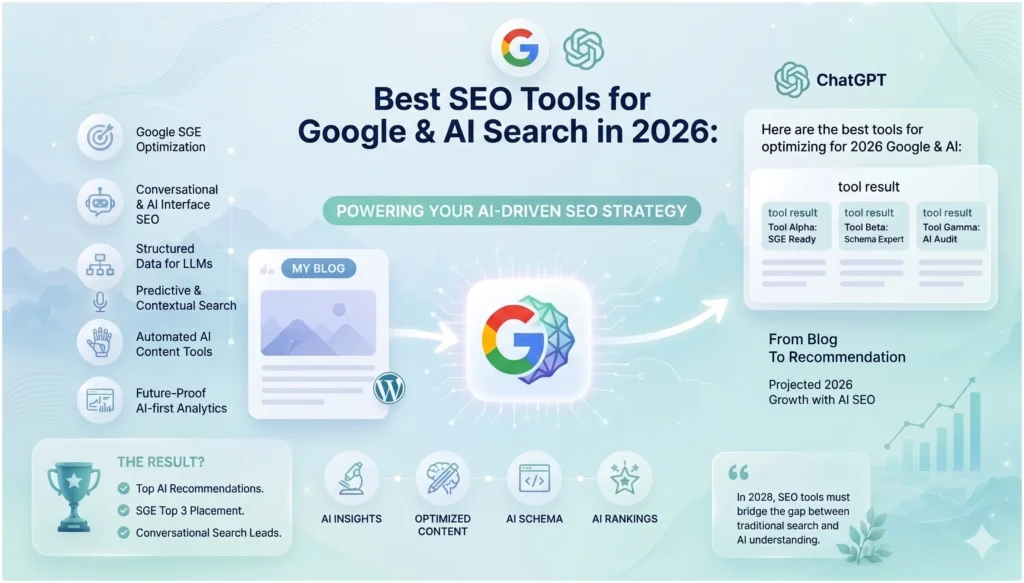
SEO in 2026 means solving two distinct problems: ranking on Google and getting cited in AI platforms like ChatGPT, Perplexity, and Gemini. These are not the same things and require different tools.
For Google visibility: Semrush, Ahrefs, or SE Ranking for keyword research and backlink data. Surfer SEO or Frase for on-page content optimization.
For AI search visibility: Otterly.ai to track where your brand appears across AI platforms. Frase to structure and optimize content for better visibility and citation potential in AI-generated answers.
The guide below separates those two jobs clearly, and for each tool, it explains its strengths, limitations, and whether it actually moves the needle for Google search, AI search, or both.
| Tool | Best for | Google / AI / Both | Starting price* | Free access / trial |
|---|---|---|---|---|
| Semrush | All-in-one SEO, competitor research & AI visibility | Both | $117.33/mo, billed annually | Limited Free Trial |
| Ahrefs | Backlink research, keyword research & AI brand visibility | Both | $129/mo | No free trial; limited free tools |
| SE Ranking | Budget-conscious SEO teams & AI visibility impact | Both | $103.20/mo, billed annually | 14-day free trial |
| Surfer SEO | Content optimization & AI search visibility | Both | $82/mo, billed annually | 7-day free trial |
| Frase | Content briefs, topic research & content optimization | Both | $39/mo | 5-day trial |
| Clearscope | Enterprise content optimization | Google-first | $129/mo | Free trial available |
| Otterly.ai | Dedicated AI visibility & citation tracking | AI | $29/mo | Free trial available |
| Screaming Frog | Technical SEO crawling & audits | Free | Free up to 500 URLs | |
| Google Search Console | Search performance, indexing & technical insights | Free | Completely free | |
| Search Atlas | Affordable all-in-one SEO with automation | $99/mo | 7-day trial | |
| Sitebulb | Visual technical SEO auditing & reporting | $180/year | Free trial available | |
| Ahrefs Brand Radar | AI mention tracking for Ahrefs users | AI | Add-on pricing varies. | No free trial |
| Semrush AI Visibility Toolkit | AI tracking inside the Semrush ecosystem | AI | ~$99/mo add-on | Check Semrush |
| AirOps | AI citation tracking plus content workflows | AI | Custom | Demo |
| Promptwatch | Dedicated AI tracking with crawler analytics | AI | $95/mo | 7-day trial |
| Wellows | AI citation tracking and outreach | AI | $37/domain/mo | 7-day trial |
If you had to only pick one:
Pick SEMRush. It’s one of those few advanced and known tools that covers both jobs in one subscription: keyword research, backlinks, and site audits for traditional Google, plus AI visibility tracking across ChatGPT, Gemini, Google AI Overviews, Perplexity and AI Mode. SEMrush is one of the SEO tools I’ve used most throughout my career, and honestly, I’ve rarely felt the need to look elsewhere. It’s one of the most comprehensive SEO platforms, covering almost every key area and providing actionable insights. Its AI Visibility Toolkit adds even more value by offering metrics such as popular search prompts, key themes, competitor data, and share of voice.
How I Tested These Tools
I’ve used most of these tools across 15+ client and personal projects over the past six years, spanning SaaS, B2C, e-commerce, and enterprise, and none of the links on this page are affiliate links.
In this blog, I’ve shared my firsthand experience evaluating these tools based on a mix of actual usage, real-world SEO work across multiple client projects, and current product capabilities. I looked at the key USPs and specializations of each tool, whether that’s keyword research, technical SEO, content optimization, or AI visibility tracking, and compared their strengths, limitations, pricing, and practical value. Most of these tools have been used across actual client campaigns, ranging from SaaS startups and B2C brands to enterprise accounts and e-commerce businesses. That’s where these recommendations come from.
Before I start with my list of recommendations, I also want to be clear that ranking on Google and getting cited by ChatGPT, Perplexity, or Gemini are two different concerns. They rely on different signals, content strategies, and increasingly, different tools.
For AI search tools, I also looked specifically at which platforms they monitor, how they collect and measure data related to brand mentions and citations, and how actionable their insights are.
The objective isn’t to recommend the tool with the longest feature list. It’s to identify which tools are actually useful for different SEO needs, budgets, and workflows.
How to Think About SEO Tools in 2026
For most of the last decade, SEO was limited to one job: ranking well on Google. All you needed was a keyword research tool, a crawler, and a rank tracker. That was the stack.
However, over the past two years, things have changed drastically in the SEO landscape, and search behavior has undergone a significant shift. There are now distinct visibility challenges to solve:
1. Google Visibility
This entails getting important pages to rank in traditional search and mainly includes keyword targeting, technical health, backlinks, on-page optimization, and related activities. The tools for these tasks are already mature and well-known.
2. AI Search Visibility (GEO/AEO)
This involves getting your content cited by AI answer engines such as ChatGPT, Gemini, and Perplexity. Success here depends heavily on structured content, entity clarity, topical depth, and how easily your answers can be extracted at the passage level. Many traditional SEO tools do not measure this at all.
It should be noted that the approach and strategy differ across these two environments. A blog post or page can rank on the first page of Google and still not get cited in AI-generated responses. On the other hand, content with zero backlinks can still be cited by ChatGPT when it is relevant to the user’s query, clearly structured, and provides useful, comprehensive information.
Read about Modern SEO Guide
What Are GEO and AEO Tools?
GEO (Generative Engine Optimization) and AEO (Answer Engine Optimization) tools help you get your brand and content cited in AI-generated answers, beyond simply ranking in Google’s traditional blue links.
They generally do three things:
- Track: Show you which prompts mention your brand, which URLs get cited, and which competitors outperform you.
- Diagnose: Help identify why your content isn’t being cited, such as weak structure, thin coverage, or unclear entities.
- Improve: Help you optimize and rewrite content into direct, self-contained answers that AI systems are more likely to extract and cite.
In short, traditional SEO tools measure rankings, traffic, and links, while GEO/AEO tools focus on citations and brand mentions. In today’s search landscape, you need both.
What to Look for in an SEO Tool in 2026
The search landscape has undergone a tremendous shift in the past few years. In 2026, below are a few things you must keep in mind while looking for an SEO tool:
- Data accuracy: Verify if the numbers roughly match with Google Search Console data? If not, don’t trust the rest.
- AI platform coverage: Which engines does it track (ChatGPT, Perplexity, Gemini, Google AI Overviews), and in which regions?
- Actionability: Does it tell you what to fix, or only report a score?
- Fit for your team: Solo consultant, agency, or enterprise? Avoid paying for features you won’t use.
- True cost: Check monthly vs annual billing and any add-ons for AI tracking.
Best All-in-One SEO Platforms (Google-First)
When you’re specifically looking for a conventional SEO tool, your priority should be to find a centralized platform that allows you to manage multiple activities, such as keyword research, competitor analysis, and site auditing, without relying on five different tools. Below are some of the most useful platforms in the Google-first SEO landscape.
1. SEMrush
SEMrush, now acquired by Adobe, is one of the most comprehensive and in-depth SEO tools currently available. It is useful across multiple SEO disciplines (on-page, off-page, and technical SEO), including keyword research, backlink analysis, site audits, rank tracking, and content gap analysis.
Best for: Agencies, consultants, and growth teams managing multiple clients or channels.
Pros: Covers keyword research, audits, backlinks and AI tracking in one subscription.
Limitation: The platform has expanded to include social media, paid advertising, and content marketing features that many SEO teams may not need. As a result, you may end up paying for functionality that goes largely unused.
AI Visibility impact: Strong. SEMrush recently launched a dedicated AI Visibility Toolkit (along with an enterprise version called Enterprise AIO) specifically designed to move beyond simple brand tracking and into LLM citation tracking and Generative Engine Optimization (GEO).
Pricing: SEMrush subscription plans start at $117.33 per month. Check SEMrush pricing here.
Who should skip it: Solo founders and small sites that only need basic rank tracking.
2. Ahrefs
Ahrefs’ primary strength lies in backlink analysis and keyword research. Its UI/UX is among the cleanest in the industry, and it is known for providing one of the most detailed backlink indexes available, often outperforming SEMrush in this area.
Best for: Teams where backlinks and authority building are the priority.
Pros: Best-in-class backlink index, clean interface, excellent keyword research.
Limitation: The site audit tool is functional but not as actionable as SEMrush’s. Additionally, there is no free trial, which requires users to commit upfront.
AI Visibility impact: Moderate, via Brand Radar.
Pricing: Starts at $129 per month. Check Ahrefs pricing here.
Who should skip it: Anyone who wants AI tracking included without an add-on.
3. SE Ranking
SE Ranking is one of the most underrated SEO tools in the industry and unfortunately doesn’t receive the recognition it deserves. It is particularly effective for startups and early-stage founders operating on limited budgets. The platform covers keyword research, rank tracking, site audits, backlink monitoring, and competitor analysis at a fraction of the cost of Semrush and Ahrefs.
Best for: Early-stage startups and founders with budget constraints.
Pros: Covers the core SEO toolkit at the lowest price of the three.
Limitation: SE Ranking has a smaller database, which makes it less competitive compared to industry giants such as Semrush and Ahrefs. However, for early-stage startups and founders, it covers most use cases effectively.
AI Visibility impact: SE Ranking includes built-in AI visibility tracking that monitors how brands appear across Google AI Overviews, Google AI Mode, ChatGPT, Gemini, and Perplexity. It tracks brand mentions, links, and AI-generated citations, allowing you to analyze visibility and the sources influencing AI answers.
Pricing: Starts at $103.20 per month. Check SE Ranking pricing here.
Who should skip it: Teams that need the deepest backlink data.
4. Search Atlas
Search Atlas is a fairly knew and an all-in-one SEO platform positioned as a lower-cost alternative to Ahrefs and Semrush. It covers keyword research with built-in clustering, backlink analysis, rank tracking and content planning. Its key highlight is OTTO SEO, an AI assistant that monitors your site and flags or automates technical and content fixes.
Best for: Agencies and SEO teams that want Ahrefs/Semrush-style data at a lower price, with automation.
Pros: OTTO SEO automates monitoring and fixes, the interface is quite familiar to Ahrefs users, with built-in keyword clustering and white-label reporting.
Limitation: A fairly new platform with limited backlink database, historical data, and some reported bugs.
AI visibility impact: Limited or indirect.
Pricing: $99/mo Starter, $199 Growth, $399 Pro, with a 7-day trial. Check latest Atlas pricing here
Who should skip it: Teams whose main requirement is deep backlink research or AI citation tracking.
Semrush vs Ahrefs vs SE Ranking – At a Glance
| Semrush | Ahrefs | SE Ranking | |
| Best for | Competitor intel | Backlinks & content | Budget-conscious teams |
| Starting price | $117.33/mo | $129/mo | $103.20/mo (annual) |
| Site audit | Excellent | Good | Good |
| Keyword research | Excellent | Excellent | Good |
| Backlink data | Very good | Best in class | Limited |
| AI visibility tracking | Available with ‘Semrush One’ with AI toolkit tracking for $99/mo | Brand Radar | AI Overview tracker |
| Free tier | Limited trial | No | 14-day trial |
Best Content Optimization Tools (On-Page + NLP)
In 2026, merely targeting individual keywords with their respective landing pages is not enough. Your content must have sufficient topical authority and coverage for Google’s NLP (Natural Language Processing) systems to recognize it as genuinely useful and helpful to users. That’s exactly what this category of tools is built for.
Surfer SEO
Surfer works by analyzing the top-ranking pages for your target keyword and reverse-engineering what they have in common. This includes word count, NLP terms, heading structure, and internal linking patterns, based on which it generates a content score that you can optimize against as you write.
This works particularly well for content teams publishing 10+ pieces per month that require a repeatable brief-to-draft workflow.
Best for: Content teams and agencies running high-volume publishing operations.
Pros: Repeatable brief-to-draft workflow with a live content score.
Limitation: Scores can push you toward copying what already ranks.
AI Visibility Impact: Surfer combines content optimization with dedicated AI visibility tracking. Its AI Tracker monitors how your brand appears in AI-generated answers across ChatGPT, Gemini, Perplexity, Google AI Overviews, and Google AI Mode, including brand mentions and cited sources. Its content optimization features also provide recommendations around topics, facts, search intent, and content coverage to help improve visibility in AI search.
Pricing: Starts at $82/month for ‘AI Search Analytics’. The Standard plan costs $99/month when billed annually. Surfer states that annual billing saves up to 17% compared with monthly billing. Learn about Surfer SEO pricing here.
Who should skip it: Solo writers publishing a few posts a month.
Frase.io
Frase is a tool that combines topic research, content brief creation, and AI-assisted drafting within a single interface. It is particularly useful for solo consultants and small content teams.
The SEO scoring works similarly to Surfer’s, but Frase’s research capabilities are stronger. Its Answer Engine feature pulls in “People Also Ask” and related question data, which is directly useful for structuring content that answers questions at the passage level. This is exactly the type of content that gets cited by ChatGPT and Perplexity. As a result, Frase is useful for both GEO/AEO and traditional SEO.
Best for: Independent consultants and small content teams optimizing for both Google and AI search visibility.
Pros: Affordable, with strong research and question-driven briefs.
Limitation: Less refined content scoring than Surfer or Clearscope.
AI Visibility Impact: Strong. Its question-driven research framework directly supports passage-level extraction by LLMs.
Pricing: Starts at just $39/month. Check Frase.io pricing here.
Who should skip it: Enterprise teams that need editorial controls at scale.
Clearscope
Clearscope falls into a more premium category of content optimization tools. It offers a cleaner interface than Surfer, more reliable NLP grading, and better integration with large-scale editorial workflows. The content grading system is intuitive enough that even non-SEO writers can use it effectively with minimal training.
The primary tradeoff is price. However, it can be a worthwhile investment if you’re running a content operation where multiple writers need consistent grading standards across dozens of articles every month.
Best for: Enterprise content teams and larger agencies that require content production at scale.
Pros: Clean interface and consistent NLP grading that non-SEO writers can follow.
Limitation: Premium pricing.
AI Visibility Impact: Strong—arguably slightly stronger than Surfer. It provides broader NLP coverage, which improves content extractability. However, Clearscope does not specifically optimize for AI citations.
Pricing: Starts at $129/month. Check Clearscope pricing here.
Who should skip it: Small teams and solo consultants.
Surfer vs Frase vs Clearscope – At a Glance
| Surfer SEO | Frase.io | Clearscope | |
| Best for | High-volume content teams | Lean teams, solo consultants | Enterprise editorial |
| Starting price | $82/mo | $39/mo | $129/mo |
| Content scoring | Excellent | Good | Excellent |
| Brief generation | Good | Excellent | Good |
| AI-assisted drafting | Yes | Yes | Limited |
| GEO/AEO relevance | Indirect | Direct | Indirect |
| Free trial | 7 days | 5-day trial | Yes |
Best Tools for AI Search Visibility (GEO/AEO)
AI answer engines, unlike Google, do not rank pages; they cite sources and links to support the information they provide. When optimizing for AEO/GEO, different signals matter, including entity authority, structured answers, topical depth, passage extraction quality, and more.
Below is a compilation of some of the best tools you can use specifically for AI visibility.
Otterly.ai
Otterly AI is built specifically for Generative Engine Optimization (GEO) and AI search visibility. It tracks how frequently, where, and in what context your brand or website appears within answers generated by AI platforms.
Best for: In-house B2B SaaS and growth marketing teams, digital PR agencies, and enterprise brands looking to scale their AI visibility.
Pros: Standalone tool covering multiple AI platforms.
Limitation: Tracks visibility only but doesn’t help you fix content.
AI visibility impact: Direct, for monitoring.
Pricing: Lite plan starts at $29/month. Check Otterly.ai pricing here.
Who should skip it: Anyone who wants tracking and content workflows in one tool.
Ahrefs Brand Radar
Ahrefs Brand Radar is an enterprise research and monitoring tool launched by Ahrefs to track brand visibility across AI search engines and modern discovery channels. Powered by Ahrefs’ massive data infrastructure, it shows you exactly where, how, and why your brand is being mentioned by AI systems.
Best for: Enterprise marketing teams and existing Ahrefs power users. Its key advantage is its extensive database, which contributes to greater accuracy and visibility tracking across AI platforms.
Pros: Backed by Ahrefs’ large data infrastructure.
Limitation: Requires an Ahrefs subscription plus an extra AI-tracking fee.
AI visibility impact: Direct, for brand mention tracking.
Pricing: Brand Radar requires an active Ahrefs subscription (minimum Lite plan at $129/month). Check Ahrefs Brand Radar pricing here.
Who should skip it: Teams that only need to track AI mentions. Otterly does that for far less.
Semrush AI Visibility Toolkit
The Semrush AI Visibility Toolkit is a specialized solution for measuring and improving AI search visibility. It helps you track, analyze, and optimize how your brand appears across AI platforms and search experiences, including ChatGPT, Gemini, Perplexity, Google AI Overviews, and Google AI Mode. Enterprise plans offer additional coverage for platforms such as Microsoft Copilot, Claude, Grok, and DeepSeek.
One of its key differentiators is its ability to provide insights into your brand’s AI footprint using Semrush’s database of more than 317 million real-user prompts.
Best for: Corporate CMOs, in-house marketing directors, SaaS and startup growth marketers, and digital PR professionals.
Pros: Draws on Semrush’s large prompt database.
Limitation: Prompt-level reporting is less granular than dedicated trackers like Otterly or Promptwatch, and it’s an add-on on top of a Semrush subscription.
Pricing: The standalone AI Visibility Toolkit is available as an add-on (approximately $99/month), while access through the broader Semrush platform is included in plans starting at $117.33/month. Check Semrush AI Visibility Toolkit pricing here.
Who should skip it: Budget-conscious teams that only want AI tracking. It’s an add-on on top of a Semrush subscription, so the total cost is higher than a standalone tracker.
Besides using the tools above, you can also manually test your own AI citation visibility directly on ChatGPT using structured prompts. Try combining intent-focused prompts that your target audience is likely to use when searching for information related to your webpages. This remains one of the simplest and most practical ways to measure your visibility and discoverability across AI and LLM-powered platforms.
AirOps
Best for: In-house content and growth teams publishing enough volume to justify one system for tracking and production.
Pros: Connects citation gaps to content workflows with human review.
Limitation: Pricing is custom, so you can’t judge the cost from the website.
AI visibility impact: Strong for teams that want tracking and production in one place. The tool is built around the loop of finding a citation gap, drafting the content to close it, and measuring whether it worked.
Pricing: Custom, based on scope and volume.
Who should skip it: Solo operators and small budgets.
Promptwatch
Promptwatch is another dedicated AI search visibility tool built to track how frequently your brand appears in responses from ChatGPT, Gemini, Claude, Perplexity, and other AI engines, as well as where it appears in those responses. Its main highlight is that it collects data from live AI interfaces rather than API calls, so the citations reflect what searchers see in real time. Its standout feature is crawler analytics: by connecting to CDNs such as Cloudflare, it shows which AI bots are visiting your pages and whether those visits result in citations.
Best for: Agencies and growing brands that need dedicated AI visibility tracking at scale.
Pros: Scrapes the live ChatGPT, Gemini, Claude and Perplexity interfaces, and shows which AI crawlers visit your pages via CDN logs (Cloudflare, Fastly, Vercel).
Limitation: No keyword or backlink data, and there’s also a learning curve around prompt and persona setup.
AI visibility impact: Direct, for tracking and for citation and crawler diagnostics.
Pricing: From $95/mo, with a 7-day trial
Who should skip it: Solo founders who only want a basic mention checker, since Otterly costs less and covers that.
Wellows
Wellows is an AI search visibility platform focused on citations rather than rankings. It tracks how your brand appear across ChatGPT, Gemini, Perplexity, Google AI Overviews and AI Mode, and summarizes your presence in an AI Visibility Score. Unlike other monitoring tools, it turns the gaps it finds into content and outreach opportunities, so you can act on them.
Best for: Brands and agencies that want to track and act on AI citations, including outreach to the sources AI engines cite.
Pros: AI Visibility Score, daily prompt tracking, competitor benchmarking, Google Search Console integration, and content and outreach workflows tied to citation gaps.
Limitation: Not a traditional SEO suite (no backlink database or deep keyword research), and per-domain pricing adds up across clients.
AI visibility impact: Direct, with tracking that also enables you to act on gaps.
Pricing: Lite $37/domain/mo; Essential $97; Starter $297 for full five-engine coverage. Check wellows pricing here
Who should skip it: Teams managing many domains on a tight budget, and anyone who wants keyword and backlink data in the same tool.
Otterly AI Vs. Ahrefs Brand Radar Vs. Semrush AI Toolkit – At a Glance
| Otterly.ai | Ahrefs Brand Radar | Semrush AI Toolkit | |
| Best for | Dedicated AI visibility tracking | Ahrefs users tracking brand mentions | Enterprise teams in Semrush ecosystem |
| Platforms tracked | ChatGPT, Perplexity, Gemini, Copilot + more | Select LLMs | ChatGPT, Gemini, Perplexity, Google AI Overviews, and Google AI Mode |
| Starting price | ~$29/mo (Lite) | $129/mo (Lite) | Add on feature from $99/mo |
| Standalone tool | Yes | No | No |
| Granularity | High | Medium | Low |
| Best entry point | Solo consultants, startups | Existing Ahrefs subscribers | Existing Semrush subscribers |
Technical SEO Tools worth Knowing
Besides exploring SEO and AI visibility tools, it also makes sense to look at tools that are specifically designed to address technical SEO issues. If a website has crawl issues, broken internal links, or poor Core Web Vitals, it will struggle to rank regardless of how good the content is.
Below are three tools that cover the essentials.
Screaming Frog
Screaming Frog is widely popular and is probably the best tool available for conducting SEO audits. It audits up to 500 URLs for free, which is more than sufficient for most small websites. For larger sites, the paid license costs $279/year and remains one of the best-value investments in SEO.
Google Search Console (GSC)
Google Search Console is one of the most non-negotiable tools for SEO and is completely free. It is essentially the only source of truth for impressions, CTR, indexing status, and Core Web Vitals performance.
If you’re not using it, you’re operating with limited visibility. In fact, GSC should be set up before you begin any SEO campaign.
Sitebulb
Sitebulb is an easier alternative to Screaming Frog, especially for professionals in client-facing roles. The interface is cleaner and converts crawl data into prioritized, easy-to-read reports that non-technical stakeholders can actually understand.
Pricing: Starts at $180/year. Check Sitebulb pricing here.
My Take
Google Search Console and Screaming Frog cover a remarkably large portion of the core technical and performance needs of many SEO teams at zero or near-zero cost. For many websites, they can be a strong foundation before investing in more specialized paid SEO tools. Sitebulb becomes valuable when you’re regularly producing technical SEO reports for clients and need a more presentation-friendly interface.
Click here to read about ‘How to Learn SEO for Free‘
Conclusion
The era of relying on a single SEO tool is over.
At a minimum, you need one paid platform for keyword research and competitor analysis (Ahrefs or Semrush), one content optimization tool (Surfer or Frase), and one method for tracking AI visibility, even if that’s simply manual testing through ChatGPT for the time being.
Read here about the complete SEO Roadmap for SaaS startups.
As search continues to evolve, the most effective SEO teams will be the ones that optimize for both traditional search engines and AI-powered discovery platforms. Google rankings and AI citations are no longer the same thing, and the tools you choose should reflect that reality.
Frequently Asked Questions
Q. Which SEO tool is best for ranking on ChatGPT in 2026?
No tool gets you cited on its own. Tools like Otterly.ai, Promptwatch or Wellows show where you appear, but citations come from content that answers questions directly in the first sentence, with original data and fresh facts. Use Frase to find the questions to answer, then re-test the same prompts monthly.
Q. Is Semrush worth it for small businesses in India?
Not necessarily. At $117.33/month, the price can be difficult to justify for many Indian startups. SE Ranking, at $103.20/month (annual billing), covers keyword research, rank tracking, and site audits at a lower cost. You can start there and upgrade only when you’ve outgrown its capabilities.
Q. What’s the difference between GEO and AEO?
AEO (Answer Engine Optimization) focuses on getting your content selected as a direct answer, such as in featured snippets and voice search results.
GEO (Generative Engine Optimization), on the other hand, focuses specifically on getting your content referenced in AI-generated responses from platforms such as ChatGPT, Perplexity, and Gemini.
Q. Can I do SEO without paid tools?
Yes. Even with just two tools—Google Search Console and Screaming Frog (free for up to 500 URLs)—you can uncover a significant amount of actionable SEO data. Together, they provide a functional technical SEO setup at virtually no cost.
For keyword research and FAQs, Google’s own Autocomplete and “People Also Ask” features are highly underrated free resources.
Q. Which tool is best for tracking whether my website appears in AI-generated answers?
Otterly.ai is one of the strongest dedicated options available. It tracks brand and content mentions across multiple AI platforms, including ChatGPT, Perplexity, and Gemini.
If you’re already using Ahrefs, Brand Radar offers basic LLM mention tracking without requiring a separate subscription. Even if you opt for ‘Ahrefs lite’ subscription plan, you’ll get the access to Ahref Brand Radar.
Q. Surfer SEO vs Frase: Which one is better?
If you’re an independent consultant or part of a small content team optimizing for both Google and AI search visibility, Frase is often the better choice. It’s more affordable, offers a stronger research workflow, and its question-driven structure is particularly useful for improving LLM citations.
If you’re managing a larger content team that publishes at scale and needs writer-friendly optimization scores and content guidelines, Surfer is likely the better fit.
Q. Do I need both a Google SEO tool and an AI visibility tool?
Yes, especially in the modern and changing search landscape. Ranking on Google and being cited by ChatGPT or Perplexity are separate problems. Many suites like Semrush and SE Ranking now cover both, so one subscription can be enough.
Q. What’s the best free SEO setup?
Google Search Console plus Screaming Frog (free up to 500 URLs) covers technical SEO and performance data. Add manual ChatGPT prompt testing to check AI citations.
Q. What’s a good SEO tool stack for a US startup on a tight budget?
You could consider pairing SE Ranking for Google SEO with Otterly.ai for AI tracking, and add Frase if you publish content regularly. All this should come under about $175/month. Upgrade to Semrush or Ahrefs only once you outgrow them.

Rahul Bajaj is an SEO strategy consultant with 6+ years of experience helping SaaS companies, startups, and enterprise brands grow organic revenue. He has worked across industries including cybersecurity, medical, automotive, SaaS, real estate, ed-tech, and sustainability brands, delivering 170%+ organic monthly traffic growth, 200%+ YoY organic growth, and 120+ AI visibility snippet wins for his clients. His expertise includes technical SEO, search-intent-driven content strategy, and AI search optimization. He writes on SEO strategy, digital marketing careers, and organic growth at Grow Digital Career.