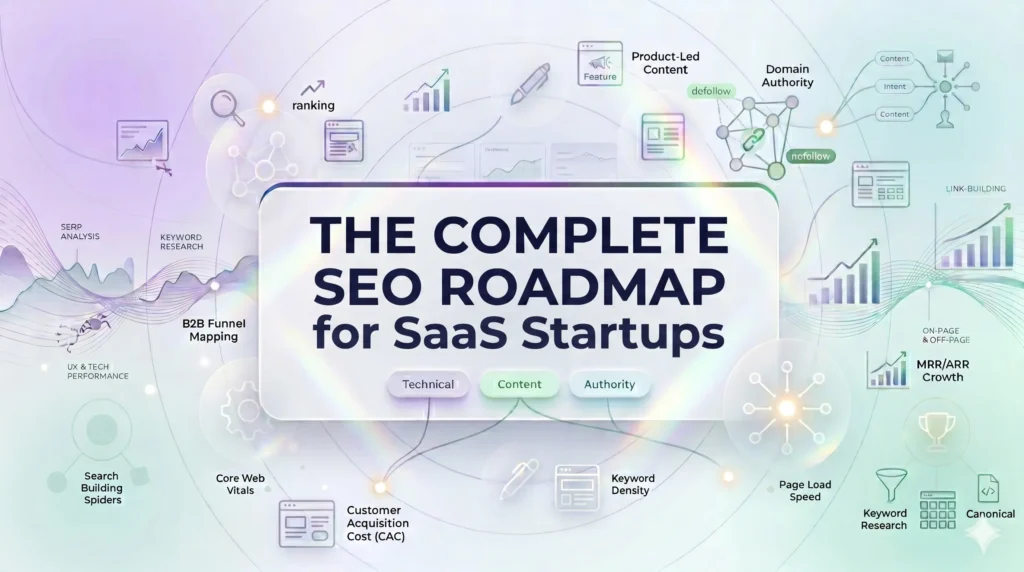
SEO is a big challenge for most SaaS founders or startups. Most companies have zero clue about the direction, priority items, or roadmap, and hence struggle a lot in terms of visibility. Especially now, when the SEO landscape is undergoing such a significant shift from traditional blue links to AI-first visibility. If done correctly, SEO can become one of the strongest channels for SaaS companies that drives quality sign-ups without incurring any heavy acquisition cost on paid channels.
If you’re a SaaS founder or startup, this guide is for you. Having spent 6+ years working with SaaS companies, I’m breaking down the exact steps or the roadmap you need to follow to scale your business organically.
What makes SaaS SEO Different from Conventional SEO, and where Startups Go Wrong?
SEO for SaaS is very different from that of an e-commerce or local business. The buyer journey is much longer and more complicated, involving cycles like conducting 10–15 searches before committing to a trial, involving multiple stakeholders, and spending weeks comparing tools before landing on your pricing page. This extended user journey changes everything about how you approach organic search.
There are 3 factors that make SaaS SEO different from conventional SEO:
- First, you’re optimizing for recurring revenue. A comparison page with 300 monthly searches and a 12% conversion rate always outperforms a “what is X” guide with 8,000 searches at 1% conversion.
- Second, the buying journey is multi-layered. If you only have TOFU, i.e., informative or educational content layer, you’re invisible at the moment someone is actually ready to act or convert.
- Third, each piece of content published on the website compounds. Unlike performance marketing or paid ads that stop the moment you stop spending; a well-executed SEO program builds an asset that appreciates over time.
In short, if you consider blogs merely as standalone pieces with no internal linking, go broad on keywords instead of owning a narrow cluster deeply, and skip the technical foundation entirely, you might even end up discovering months later that half the pages aren’t indexed in the first place. SEO is not just a traffic channel; it is also a compounding revenue engine.
SEO Readiness Checklist for SaaS Startups – Start with this First
Before you get any written piece of content published onto the website, make sure you check the below elements first to make your website foundation strong before your content starts getting visible over search engines like Google or other AI answer engines like ChatGPT, Gemini, etc.
Technical baseline:
- Google Search Console set up and your domain verified
- All key pages (homepage, features, pricing) confirmed as indexed
- Core Web Vitals passing – check via PageSpeed Insights
- Site rendering correctly on mobile
- Blog hosted on your root domain (yoursaas.com/blog), not a subdomain (blog.yoursaas.com) – subdomains don’t pass authority to your main domain
Keyword foundation:
- List 3–5 core problems your product solves
- Map each problem to a funnel stage – is someone searching this ready to buy, or just gaining information?
- Identify 10 starter keywords with keyword difficulty under 20 before writing anything
Content infrastructure:
- All the important content must be crawlable and not blocked by robots.txt
- A rough internal linking plan – interlinking of related posts before you publish
- A basic content brief template so every post is written to rank, not just to exist
Click below to download Free SEO Opportunity Checklist:
Keyword Strategy for SaaS Founders – Start from Where the Money Is
Generally, the tendency for SaaS founders is to target keywords that have high search volume, as they somehow equate that to a higher amount of website traffic. However, that’s exactly where things go wrong. High-volume keywords are highly competitive and mostly informational in nature, which might attract the wrong audience in the first place. The smarter approach is to instead target those keywords where the buying intent is high and which fall under the transactional or commercial category, irrespective of their search volume.
Start with the below framework:
- Start with BOFU (transactional/commercial) keywords first: When you target BOFU (Bottom of the funnel) keywords, you already know the buying intent of people looking for solutions/services is high. Some examples of such pages include:
- Comparison Pages – [Your product] vs [Competitor]
- Guide Page – Best [Competitor] alternatives
- Landing Page – [Category] software for [specific use case]
- Pricing Page – [Your product] pricing
- Review/Product Testimonial Page – [Your product] reviews
- MOFU Keywords: MOFU keywords fall somewhere in the middle of the buyer journey at the stage of evaluation and comparison. At this stage, the intent is clear, but users are considering different options to make the best decision. This is where you have to focus on comparison guides with competitors, publishing landing pages to highlight product USPs, etc. One such example could be “Best cost-effective low-code automation solution”.
- TOFU Keywords: TOFU keywords come last. Such keywords are generally informational in nature, whose objective is to educate the audience and make them aware of the solution/product. Their intent might not be to convert, but simply to gain information. These keywords are mainly meant to build topical authority and internal linking, but they must never be where you start.
Click here to learn about Modern SEO Strategy
Keyword Research Process for SaaS Companies
- Open Ahrefs or Semrush – even the free tier works at this stage
- Enter your 3–5 core seed keywords
- Filter for KD under 20 and monthly volume above 50
- Look at what your top 3 organic competitors rank for that you don’t – this is your competitor gap list
- Filter down to your first 10 keywords, not beyond that
Note: Always ensure that each keyword has a standalone page mapped alongside it.
Content Architecture for SaaS Startups – The Hub and Spoke Model
Google no longer ranks standalone random pieces of content. It prioritizes websites that demonstrate deep expertise on a particular theme or subject matter. It is like building a structured cluster of content where every piece reinforces the other and builds topical depth.
How the content framework works?
A pillar post covers a broad topic widely (like this one). Cluster topics (spokes) go deep into particular subtopics. Each cluster links back to the pillar content and vice versa. This interconnected web of content passes authority to one another and signals this to Google, making it harder for thin competitors to outrank you.
If you are a founder who’s just starting out, I would advise you to start smaller:
- 1 pillar post
- 5 cluster posts covering the most searched subtopics
- Every cluster internally linked to the pillar and to at least 2 other clusters
This is what a functional authority hub looks like. Ensure you build one cluster completely before starting another.
A concrete example of this content architecture:
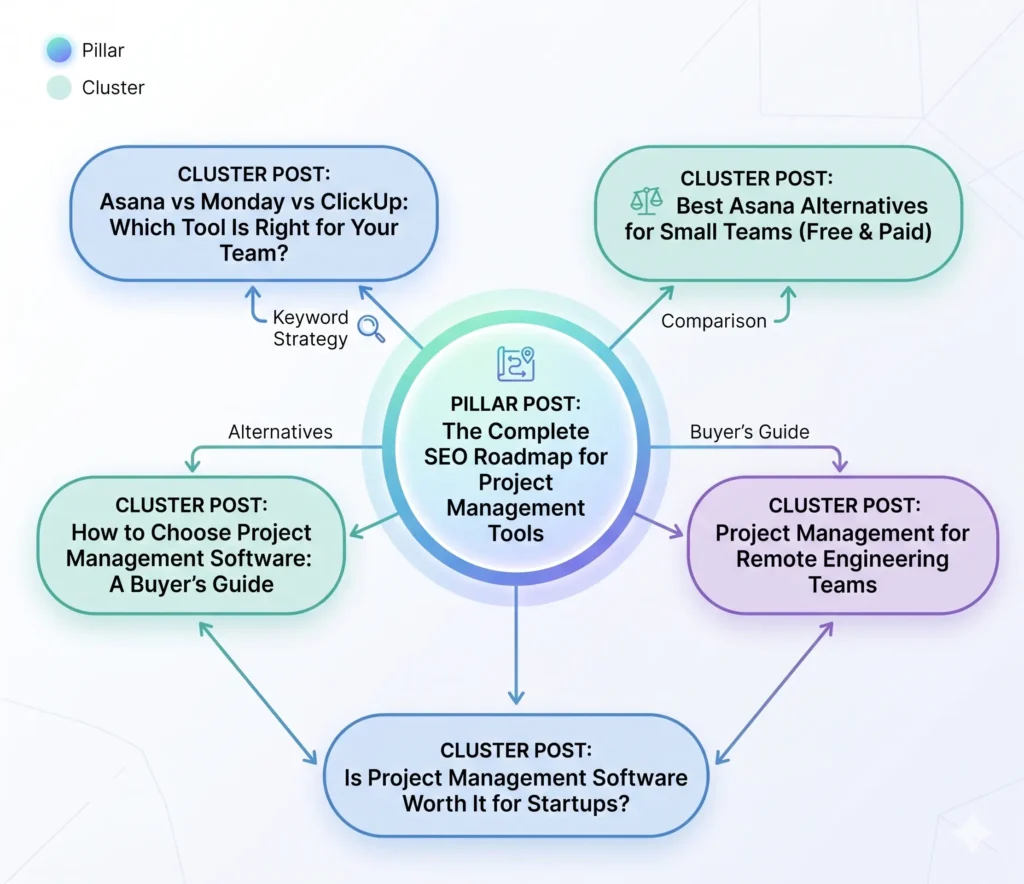
Note: Prioritise the cluster with the highest BOFU density first. If your comparison and transactional pages belong to a cluster, that cluster must be built before anything else.
Content Types That Actually Drive SaaS Signups
Start by publishing the below content in the same order:
- Comparison and alternatives pages: These pages are the highest converting and are still mostly ignored at the early stage. Someone searching “Asana vs Monday” has very high buying intent. Build one comparison page per top competitor – keep it honest, in feature table format, with a clear “who should choose which” verdict, and quarterly updates. Keep your tone subtle and neutral. It must not be opinionated or salesy.
- Feature and use-case landing pages: Before blog posts, pay attention to SEO-optimized landing pages targeting a specific buyer (“project management for remote engineering teams”). Highlight one core use case, one key feature, screenshots, a short demo, and a direct trial CTA. These elements convert better than a generic features page.
- Problem-first guides (MOFU): These guides target SaaS buyers who know they have a problem but haven’t evaluated or compared tools yet. Cover the problem thoroughly before mentioning your product – don’t make the mistake of making the tone salesy. Focus more on adding value and solving problems for your users.
- Programmatic SEO pages: These are template-generated pages built from structured data at scale, including integration pages, industry-specific use cases, workflow combinations, etc. This serves high leverage but only works with sufficient domain authority and structured data.
Note: This is a Month 6+ strategy for most startups. Don’t build this at an early stage. - Original data and research: Back your statistics with a survey or benchmark report. These resources serve as link magnets, helping you earn quality backlinks passively, where other writers cite your findings without you doing outreach. Save this for Month 4+ once you have a solid audience base to distribute it to.
Technical SEO for SaaS Startups – The Non-Negotiable Checklist
Technical SEO plays a vital role in helping you build a solid foundation before you even begin publishing content on the website. A few checklist items that kill SaaS rankings are listed below.
- Ensure that the blog is always hosted on a root domain and not a subdomain
- JavaScript rendering issues if your website/blog is built on React or Next.js
- Duplicate content from free trial/app subdomains
- Missing canonical tags on pagination or filter pages
- No schema markup – especially FAQ and Software Application
- Core Web Vitals/Page Loading Speed: what to target, how to check, who to hand it to
- Mobile responsiveness of web pages
- Identifying where technical SEO is the bottleneck and where content is the bottleneck
How to Get Your SaaS to Show Up in AI Search Results or Answer Engines
Search behaviour has undergone a drastic shift in the last couple of years, and now tools like Google AI Overviews, ChatGPT, and Perplexity are answering questions that your buyers used to click through websites for. It is no longer optional to show up on these AI tools, especially at a stage where users might be actively evaluating options or tools.
What AI search means for SaaS specifically?
AI overviews have started dominating nearly half of all informational searches. However, for SaaS, the good news is that for BOFU and comparison content (which is the highest priority), AI engines still link out rather than summarize the answer. Some examples include “Asana vs Monday” or “Best workflow automation software for employees”. The only risk is for your TOFU and MOFU content, where AI is increasingly answering the question directly without sending traffic to you.
However, this doesn’t mean you stop publishing content. You just need to publish differently.
How to optimize your SaaS content for AI Citation
To get your content cited by AI tools, follow the below strategies:
- Use direct answer blocks: Focus on user pain points and answer the question in one or two sentences within the first 150 words. AI engines extract passage-level answers, not full articles.
- Use FAQ schema: FAQs have become more important than ever. Support this section with structured schema to signal that your content answers user queries clearly.
- Keep the tone neutral and unopinionated: Focus on clarity and addressing user pain points directly.
Optimizing for LLM visibility
LLM tools like ChatGPT and Perplexity evaluate sources differently compared to Google. For SaaS, they prioritize sources that appear across multiple authoritative contexts such as review platforms, editorial publications, and communities.
There are 3 things that actually move the needle:
- Get listed on aggregator websites like G2, Capterra, and at least two editorial publications
- Build entity authority with consistent positioning and schema across all websites, listings, and platforms.
- Get mentioned in community discussions and forums: This includes getting cited on platforms like reddit, slack, linkedin post, etc. When someone looks for ‘best project management tool for remote teams’, Reddit thread gets passive AI visibility that ultimately drives decision making and builds trust among the users.
SEO Roadmap for SaaS Enterprises and Startups (0 → 100K Traffic)
Most SEO timelines are measured in months. However, the below roadmap is a stage-by-stage analysis tied to MRR instead—because where you are in the business determines what SEO should be doing for you.
Stage 1: Pre-PMF (Under $10K MRR)
Don’t focus on being aggressive with content yet. Your positioning may still change in the future, and content built on the wrong messaging is wasted effort.
Focus on:
- Setting up the technical baseline from Section 2
- Identifying 10 BOFU keywords
- Publishing 1–2 posts per week at maximum
Time investment: 4–5 hours per week, founder-led.
Stage 2: Post-PMF ($10K–$100K MRR)
By this stage, you know who your customer is. So, you can start by building the first content cluster (pillar post plus 5 clusters), with BOFU pages live and internal linking in place. Start basic link building: guest posts, directory listings, G2 and Capterra profiles.
When to consider hiring: when SEO takes more than 8–10 hours of your week consistently.
Stage 3: Growth ($100K–$500K MRR)
In Stage 3, shift your focus towards building topical authority. This comprises:
- Two to three fully built clusters
- Programmatic pages (if your product supports it)
- 10–15 backlinks per month
At this stage, you can bring in a dedicated SEO resource, either a strong freelancer or your first in-house hire, and gradually move yourself out of execution.
Stage 4: Scale ($500K+ MRR)
In your final stage, start competing for head terms, launch an original strategy for link acquisition, and layer in AI citation tracking as a core metric to measure. By this stage, SEO becomes a function, not a task.
The startups that win at SEO aren’t the ones that started with heavy budgets; they’re the ones that started with the right priorities that kept compounding.
What SEO Metrics Do SaaS Founders Need to Measure?
As a founder, it’s important to track and measure the right metrics rather than those that offer no real value in guiding your decisions. Below are a few key metrics you should focus on at the early stage:
Stage 1:
- Pages indexed
- Keywords in top 50
- Organic sessions
Stage 2:
- Keywords in top 10
- Organic signups
- Pages per session
Stage 3+:
- Organic vs paid CAC
- MRR from SEO
- AI citation count
Avoid vanity metrics like domain authority or total backlinks, especially during the initial phase.
When to Do SEO Yourself Vs Hire
As a founder of a SaaS enterprise, before you decide on hiring an SEO professional or doing it yourself, ask these 3 questions:
- Is organic your primary acquisition channel?
- Do you have $3K–5K/month to spend?
- Do you have 8–10 hours a week to give to it?
If the answer to all three is yes, hiring is the best choice. If not, keep it founder-led for now.
Founder-led SEO generally makes sense pre-PMF and through early Stage 2, as you understand the customer better than any agency will in the first 90 days.
Consider hiring a freelancer or consultant as your first hire. This works best for early-stage startups, as it involves lower cost than an agency and offers more accountability. Look for someone who can show you keyword-to-ranking evidence from previous work, AI visibility content briefs, and not just traffic graphs that could mean anything.
An agency becomes the right option only at Stage 3+ when you have enough content infrastructure to justify the retainer. A good agency accelerates what’s already working, but it can’t build the foundation for you.
The One-Page SEO Checklist
To sum up the entire blog, below are the few checklist items I would recommend any SaaS founder starting with first.
- Technical baseline ✓
- BOFU keywords identified ✓
- First cluster mapped (1 pillar + 5 clusters) ✓
- Internal linking structure ✓
- AI Overview optimization layer ✓
- Metrics dashboard set up ✓
Frequently Asked Questions
Q. How long does SEO take for a SaaS Startup?
A. For a SaaS startup, it could take 3–6 months for long-tail keywords, 9–12 months for competitive terms, and 12–18 months for SEO to become a meaningful acquisition channel. Content repurposing and distribution through channels like LinkedIn, email, and communities can reduce this timeline considerably.
Q. What’s the first content a SaaS startup should publish?
A. Start with BOFU-intent content such as comparison pages or alternative pages targeting your closest competitors. Keep the page focused on users actively evaluating tools instead of publishing broad industry guides too early.
Q. Is programmatic SEO worth it for early-stage startups?
A. Programmatic SEO is valuable, but usually not before reaching at least $100K+ MRR. It requires strong domain authority, structured data, and engineering resources to scale effectively. On an early-stage domain, it often creates thin pages that fail to rank and waste crawl budget.
Q. How to rank in AI search?
A. To improve visibility in AI search results, SaaS companies should use direct summary blocks near the top of content, conversational language, FAQs, strong internal linking, and EEAT signals. Getting listed on platforms like G2, Capterra, and editorial publications also improves AI visibility because LLMs heavily reference these sources.
Q. How much should a SaaS startup spend on SEO?
A.
Stage 1: ~$100–200/month for keyword research and SEO tools.
Stage 2: ~$1,500–3,000/month for a freelancer or consultant.
Stage 3+: ~$3,000–6,000/month for an agency or in-house SEO hire. Spending significantly beyond this before achieving product-market fit is usually premature.
Q. What’s the difference between SEO for SaaS and traditional SEO?
A. SaaS SEO differs from traditional SEO because it involves:
- a longer multi-touch buying journey
- recurring revenue, making even low-volume keywords highly valuable
- content that compounds into a long-term moat, unlike ecommerce or local SEO where rankings can be more volatile

Rahul Bajaj is an SEO strategy consultant with 6+ years of experience helping SaaS companies, startups, and enterprise brands grow organic revenue. He has worked across industries including cybersecurity, medical, automotive, SaaS, real estate, ed-tech, and sustainability brands, delivering 170%+ organic monthly traffic growth, 200%+ YoY organic growth, and 120+ AI visibility snippet wins for his clients. His expertise includes technical SEO, search-intent-driven content strategy, and AI search optimization. He writes on SEO strategy, digital marketing careers, and organic growth at Grow Digital Career.