Key Insights:
What’s the best free SEO certification?
HubSpot’s SEO Certification Course (free, ~4 hours) and Ahrefs’ SEO Training Course (free, ~2 hours) are the most widely recognized free certified SEO courses, covering keyword research, on-page SEO, and link building.
Is there an official Google SEO certification?
Google doesn’t offer a dedicated “SEO certification.” However, you can enroll for Google’s Digital Garage and Skillshop/Google Analytics courses, which cover similar skills but aren’t entirely SEO-specific certifications.
Which paid SEO certification is worth the money?
Moz’s SEO Essentials Certificate (~$595, 8 hours) and the UC Davis SEO Specialization on Coursera (free to audit, paid for a certificate) offer the most extensive course curriculum for the price. Most other paid alternatives add cost without adding proportional value.
How long does it take to get SEO certified?
Most beginner certifications take somewhere between 1 and 4 hours. In-depth programs like UC Davis’s specialization with extensive modules run 3 months at roughly 10 hours a week.
Do employers actually care about SEO certifications?
A. They help you understand the basic concepts and build a foundation, but they are not necessarily the primary hiring factor. Exposure to practical projects along with the hands-on skills still matters more.
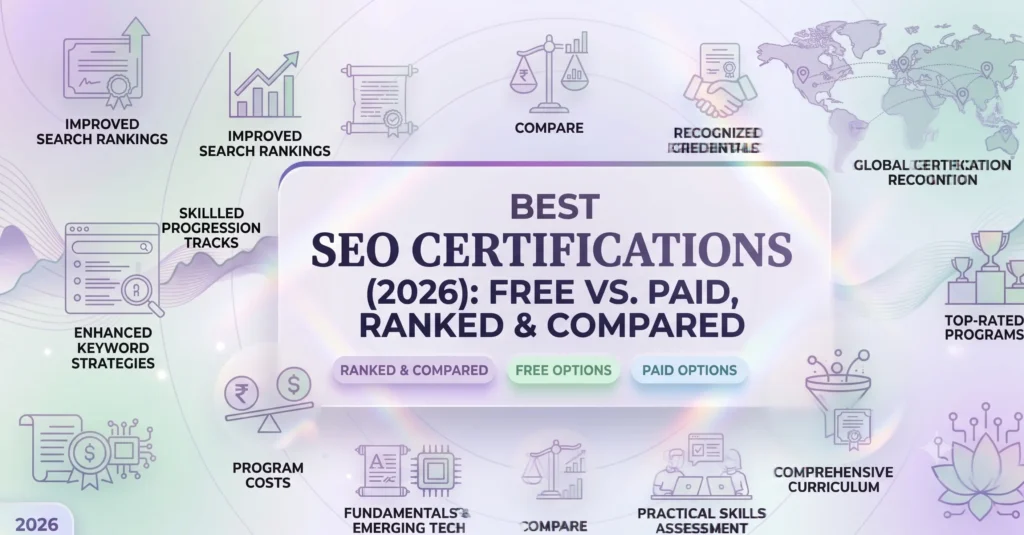
SEO certifications typically range from free one-hour crash courses to $1,500+ bootcamps. All the courses might not be worth your time; hence, this guide is an independent take on the most recognized options across every major provider, without favoring one platform’s own courses over the rest. We’ve made a point to include the cost, hours, and real value alongside the course details so it becomes easier for you to pick one.
SEO Certifications & Courses Compared (2026)
| Certification | Provider | Cost | Length | Certificate? | Best For |
| SEO Certification Course | HubSpot Academy | Free | ~4 hrs | Yes | Beginners, all-around foundation |
| SEO Training Course | Ahrefs Academy | Free | ~2 hrs | No formal cert | Quick practical intro |
| SEO Crash Course (Brian Dean) | Semrush Academy | Free | ~50 min | Yes | Fast, step-by-step beginner system |
| On-Page and Technical SEO Course | Semrush Academy | Free | ~1 hr | Yes | Technical SEO basics |
| SEO for Beginners | Yoast Academy | Free | ~2 hrs | No (paid tier available) | WordPress users |
| SEO Essentials Certificate | Moz Academy | $595* | ~8 hrs | Yes | In-depth, tool-agnostic depth |
| Google SEO Fundamentals | UC Davis (Coursera) | Free to audit / paid for certificate | ~29 hrs (4 modules) | Yes | Academic depth, credibility |
| SEO Specialization | UC Davis (Coursera) | Financial aid available | 3 months, ~10 hrs/week | Yes | Comprehensive, career-changers |
| SEO Certification | ClickMinded | ~ $999 | 3-6 hrs | Yes | Agencies/consultants wanting a formal cert |
| Search Engine Optimization Training | Simplilearn | ~ $899 to $1,499 | Self-paced, 90-day access | Yes | Most comprehensive paid option |
| Intro to SEO | WordPress.com | Free | ~1 hr | No | Absolute beginners |
| SEO Training for Beginners | Shopify Learn | Free | ~1 hr | No | Ecommerce beginners |
SEO Courses Compared
HubSpot SEO Certification Course
Provider: HubSpot Academy
Cost: Free
Length: ~4 hours (8 lessons, 26 videos)
Certificate: Yes
Backed by HubSpot’s Director of Acquisition and an Academy instructor
Best for: Beginners who want one broad, well-structured foundation
Course link: https://www.hubspot.com/resources/courses/seo
This is the most comprehensive free option on this list. It covers key concepts such as search engine fundamentals, site audits, keyword research, technical SEO basics, and reporting, etc.
Verdict: The best starting point if you’ve decided to enroll for one free course. It won’t make you an expert, but it covers more ground than any other free option in this list.
Semrush SEO Crash Course (with Brian Dean)
Provider: Semrush Academy
Cost: Free
Length: ~50 minutes (7 videos)
Certificate: Yes
Backed by: Brian Dean, founder of Backlinko
Best for: Beginners who want a fast-paced, no-fluff course module rather than an extensive curriculum
Course link: https://www.semrush.com/academy/courses/semrush-seo-crash-course-with-brian-dean/
It is shorter and more prescriptive than HubSpot’s SEO course and is built around a specific step-by-step ranking process rather than broad coverage.
Verdict: Second best option after HubSpot, or first if you want speed over depth. If you already have an understanding of the SEO basics, you might skip this one.
Semrush On-Page and Technical SEO Course
Provider: Semrush Academy
Cost: Free
Length: ~1 hour
Certificate: Yes
Best for: Anyone who needs a quick technical SEO refresher
Course link: https://www.semrush.com/academy/courses/on-page-seo-essentials-with-semrush/
The site structure is narrow by design, covering technical SEO such as site audits, HTTPS issues, crawlability, and on-page fixes, but not broader strategy.
Verdict: The course is useful as a ‘good to have’ supplement, but not a standalone certification to lead with on a resume or LinkedIn.
Ahrefs SEO Training Course
Provider: Ahrefs Academy
Cost: Free
Length: ~2 hours (14 lessons, 4 modules)
Certificate: No formal certificate issued
Best for: Practical learners who want tool-focused fundamentals
Course link: https://ahrefs.com/academy/seo-training-course
The course curriculum covers keyword research, on-page SEO, and link building without promoting Ahrefs’ own tools disproportionately. It is one of the more balanced free courses available.
Read about the best SEO tools for Google and AI visibility
Verdict: The course is backed up by strong content, but skip it if you’re particularly looking for a certificate to show on a resume or job application.
Moz SEO Essentials Certificate
Provider: Moz Academy
Cost: $595
Length: ~8 hours
Certificate: Yes
Best for: Learners who want an in-depth module and are open to paying for it
Course link: https://academy.moz.com/path/seo-essentials-moz-certification
Moz SEO Essentials is one of the most rigorous single-provider paid options on this list. It has an extensive module covering SEO basics and leading through link building and reporting in real depth.
Verdict: It’s absolutely worth it if you’re serious about a career in SEO pivot and want a credential with real substance behind it. However, if you just need a certificate for resume-line recognition, the free HubSpot course covers similar ground for $0.
Yoast SEO for Beginners
Provider: Yoast Academy
Cost: Free (paid Academy tier available at ~$118/year)
Length: ~22 to 26 hours (most courses are self-paced)
Certificate: Not on the free tier
Best for: WordPress site owners specifically
Course link: https://yoast.com/academy/free-seo-training-seo-for-beginners/
Covers keyword research, copywriting, site structure, and technical SEO concepts like crawling and indexing, all through a WordPress lens.
Verdict: Particularly useful if you run a WordPress site, as the examples provided are all platform-specific throughout.
UC Davis SEO Specialization (Coursera)
Provider: University of California, Davis
Cost: Free to audit; financial aid available for the paid certificate track
Length: 3 months at ~10 hours/week (5 courses + capstone)
Certificate: Yes
Best for: Career-switchers who want the most academically credible option
Course link: https://cpe.ucdavis.edu/section/search-engine-optimization-seo-specialization-coursera
Five sequential courses leading to a full-fledged capstone project (competitive analysis, keyword mapping, SEO pitch). This is the closest thing to a formal SEO degree currently available.
Verdict: The best-credentialed authorized option in the list, but it requires a serious time commitment. Don’t start this expecting a weekend project.
Google Analytics 4 (Skillshop)
Provider: Google
Cost: Free
Length: Self-paced, a few hours
Certificate: Yes (GA4 certification, not an SEO certification)
Best for: Complementing an SEO skill set with measurement fundamentals/framework
Course link: https://support.google.com/analytics/answer/15440208?hl=en
Since there’s no official “Google SEO certification,” this is the closest Google-backed credential that’s actually relevant and useful for those interested in SEO. However, the curriculum focuses more on the analytical or reporting part of SEO and might spread thin on the other essential concepts.
Verdict: A useful complement to any of the certificates above, but not a substitute for one.
Simplilearn / ClickMinded (paid bootcamp options)

Provider: Simplilearn (~$1,499) / ClickMinded (~$999)
Cost: $999–$1,499
Length: 3–6 hours (ClickMinded) / 90-day self-paced access (Simplilearn)
Certificate: Yes, both
Best for: Learners who specifically want a premium, all-in-one paid bootcamp with lifetime access materials
Course Link Simplilearn: https://www.simplilearn.com/digital-marketing/seo-specialist-masters-program-training
Course link ClickMinded: https://www.clickminded.com/
Both cover similar ground to Moz at a higher price point, with added extras (ClickMinded’s five mini-courses, Simplilearn’s broader curriculum including content marketing and analytics).
Verdict: The costing is honestly hard to justify unless you specifically want the lifetime-access format or your employer is covering the cost. Moz covers comparable ground for almost half the price of Simplilearn.
Free vs. Paid Courses: How to Decide
You don’t need a paid SEO certification in 2026. The free options (HubSpot, Ahrefs, Semrush’s crash courses) cover the same core fundamentals as most paid ones. However, what paid certifications actually buy you is depth, structure, and in some cases, a more recognizable credential.
Go free if:
- You’re just starting out and want to explore SEO as a career stream
- You already have hands-on experience and mainly want a resume-line credential
- Budget is a real constraint. The free courses cover fundamentals adequately and widely
Go paid if:
- You want a structured, sequential curriculum rather than piecing together multiple free courses randomly
- You’re making a career switch and want the most substantial credential available (UC Davis’s Specialization is the strongest option here)
- Your employer is covering the cost
Skip paid entirely if:
- Your only goal is a certificate to list on LinkedIn or CV. A free HubSpot or Semrush certificate does that job just as well
- You’re comparing $999–$1,499 bootcamps against Moz’s $595 course. In this case, the content overlap is significant enough that the cheaper option usually wins
Are SEO certifications worth it in 2026?
Yes, they are but not for the reason most people assume. A certification alone won’t get you hired or a promotion. The actual skill, when it comes to SEO is still built by exposing yourself to the real world projects including auditing websites, testing changes, and watching the implications.
SEO certifications genuinely help in two ways:
- Filling the knowledge gaps quickly, and
- Giving you a structured starting point instead of learning through random blog posts and trial and error.
Most importantly, since SEO and user search behavior have evolved significantly over the past few years, a certification built merely around ranking in traditional Google results is now teaching only half the picture. Visibility today means showing up in AI Overviews answers, ChatGPT, and Perplexity responses, which typically work on different mechanisms (extractability, structured data, citation-worthy content) than classic keyword-and-backlink SEO. Most certifications, including several on this list, haven’t fully caught up to that shift yet. The ones that have, like Semrush’s Keyword Research Essentials course, explicitly covering AI prompt visibility are worth prioritizing over older, more traditional courses covering the same ground.
So the honest verdict: get a certification to build foundational knowledge fast, especially if you’re starting from zero. But treat it only as a starting point. Most importantly, lean toward the courses that acknowledge changing search landscape, not ones still teaching SEO as if 2020-era Google is the only audience that matters.
Read here to learn how you can learn SEO for free
Frequently Asked Questions
Q. Is there an official Google SEO certification?
A. No. Google does not offer a certification specifically for SEO. The closest official Google credentials are Google Analytics 4 (Skillshop) and Google Digital Garage courses, which cover related digital marketing and analytics skills but aren’t SEO-specific.
Q. What’s the best free SEO certification?
A. HubSpot’s SEO Certification Course is the most complete free option, covering fundamentals through technical basics and reporting in about 4 hours. Semrush’s SEO Crash Course with Brian Dean is a faster alternative if you want a shorter, more prescriptive path.
Q. Do SEO certifications expire?
A. Most don’t have a hard expiration date, but the content behind them can become outdated. A certification completed 3-4 years ago on classic on-page/off-page SEO won’t reflect how AI search visibility works today – the credential itself may still be valid, but the knowledge may need refreshing.
Q. How much should I expect to pay for a good SEO certification?
A. You don’t need to pay anything to get a solid foundation – free options like HubSpot and Ahrefs cover core fundamentals well. If you do want to pay, Moz’s $595 course offers the best depth-to-cost ratio; the $999-$1,499 bootcamps add relatively little beyond that for most learners.
Q. Which SEO certification is best for beginners with zero experience?
A. HubSpot’s SEO Certification Course is the most beginner-friendly starting point – free, broad, and roughly 4 hours. Follow it with a more focused course (technical SEO or keyword research) once you’ve got the basics down.

Rahul Bajaj is an SEO strategy consultant with 6+ years of experience helping SaaS companies, startups, and enterprise brands grow organic revenue. He has worked across industries including cybersecurity, medical, automotive, SaaS, real estate, ed-tech, and sustainability brands, delivering 170%+ organic monthly traffic growth, 200%+ YoY organic growth, and 120+ AI visibility snippet wins for his clients. His expertise includes technical SEO, search-intent-driven content strategy, and AI search optimization. He writes on SEO strategy, digital marketing careers, and organic growth at Grow Digital Career.