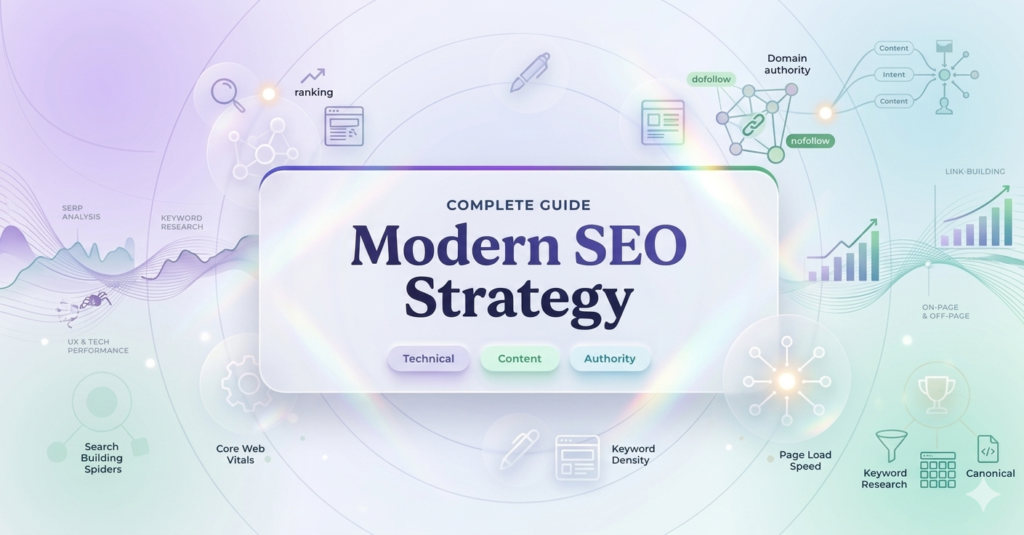
In the last few years, ‘Search Engine Optimization (SEO)’ has undergone a sharp change. It is no longer just about sprinkling some keywords here and there, and boom, your website starts ranking. The scope has expanded much beyond that, and there are nuances you need to take extra care of while optimizing for not just Google, but also for featuring your website on AI/LLM tools like ChatGPT, Gemini or even finding a place in the Google’s AI Overviews.
More than keywords, SEO is now more about intent mapping and discovering your target audience at the right stage of the marketing funnel, be it awareness, consideration and conversion.
So, if you are a start-up, business founder, marketer who’s looking for featuring their or their client’s website and gaining better visibility on these platforms, or wants to know how the modern SEO landscape looks like, this blog is for you.
In this blog, I’ll break down the exact step-by-step framework required for making your website more discoverable and gain better visibility not only for Google, but also AI/LLM tools.
What Is Modern SEO and How It Works in 2026
Modern SEO refers to the mechanism of optimizing your website for not just search engines like, but also for AI/LLM tools, AI assistants, answer engines, etc. Contrary to conventional SEO that primarily focused on keywords, modern SEO landscape has expanded to intent mapping and discovering your target at the right stage of their marketing journey. In short, modern SEO has transitioned from keywords to building topical authority, entity clusters, and most importantly dominating the web space every time any user looks for your products or solutions.
Traditional SEO vs Modern SEO 2026
Below are some key differences between Traditional and Modern SEO:
| Aspect | Traditional SEO | Modern SEO (2026) |
|---|---|---|
| Primary Focus | Keywords & rankings | User intent & value |
| Keyword Usage | Exact-match keywords stuffed in content | Natural language, semantic keywords, intent-based |
| Content Style | Generic articles were working | Insightful, experience-driven, human-first content. More focus on EEAT, real world insights. |
| AI Usage | Not used / avoided | Used strategically (briefs, outlines, optimization) |
| Content Quality | Quantity over quality | Quality + uniqueness + usefulness |
| Google Priority | Keywords + backlinks | E-E-A-T (Experience, Expertise, Authority, Trust) |
| Backlinks | Mass link-building, directories, PBNs | High-quality, relevant, editorial links |
| Technical SEO | Basic (meta tags, sitemaps) | Advanced (Core Web Vitals, UX, site architecture) |
| User Experience (UX) | Not a major factor | Critical ranking factor |
| SERP Features | 10 blue links focus | Featured snippets, AI answers, video, images |
| Topical Authority | Single keyword targeting | Topic clusters & content ecosystems |
| Measurement Metrics | Rankings & traffic | Conversions, engagement, retention |
| Content Creation Process | Write → publish | Research → topical clusters → intent mapping → create → optimize → update |
| Personalization | Same results for all | Personalized & context-based results |
| Voice & AI Search | Not considered | Optimized for conversational queries |
| Goal | Rank on Google | Solve user problems + build authority |
How search engines work in 2026
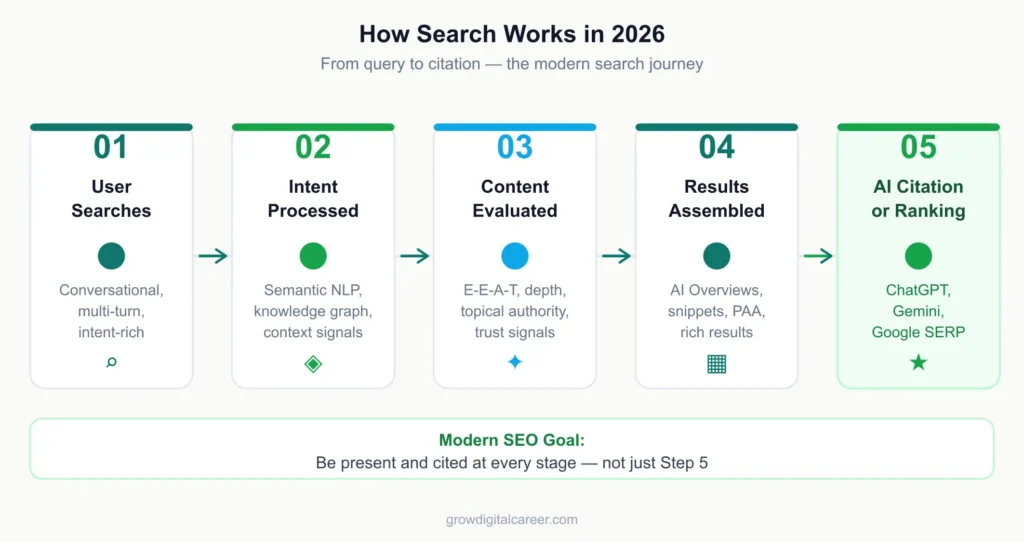
Search engines in 2026 work on the basis of semantic understanding of the keywords people type to discover any information, product, or solution. The SEO landscape has shifted now from keywords to intent mapping, trusting and prioritizing original, authentic sources of content, building topical clusters around a particular theme, expert-led original insights, and content helpfulness.
Besides the above factors, keeping the tonality of the content conversational in nature increases the likelihood of getting it featured on AI Overviews and also gain good visibility across other AI/LLM tools like ChatGPT, Gemini, Perplexity, etc. They rely on generating zero-click AI-synthesized responses from multiple sources, providing direct answer blocks to the users and meeting their search intent instantly without them having to actually visit the landing page.
The core remains the same; that is, surfacing high-quality, helpful, and authoritative content to the users that actually meets their expectations, proving usefulness to them. Moreover, the focus is also shifting towards optimizing for AI agents or assistants as well, who would have the capability of performing the actions on behalf of the users without requiring them to even visit the landing page.
Top 5 Modern SEO Strategies That Work in 2026
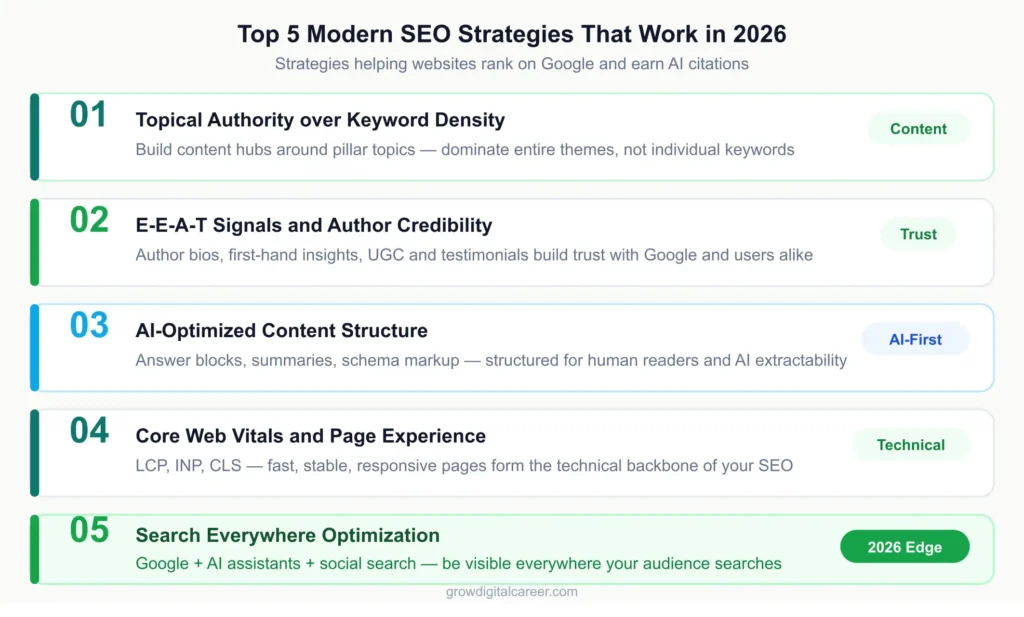
Below are the top 5 SEO strategies that actually work in 2026, helping your website get cited not on Google’s AI Overviews but also on the other answer engines such as ChatGPT, Perplexity, etc.
1. Topical Authority over Keyword Density
In 2026, if you think just sprinkling some keywords here and there throughout the content would help you rank better, you are highly mistaken. The focus has now shifted from targeting individual keywords to building dominance across certain themes or categories in order to build some level of trust and demonstrating expertise in a particular subject matter, also referred to as ‘Knowledge Graphs‘. This requires backing your content strategy through building a solid content hub revolving around pillar content and crafting supporting topics around it.
Learn how SEO drives revenue for the business
Google supports original, real-world insights on a particular subject matter reinforced by demonstrating expertise and experience through author bios, UGC (user-generated content), Customer testimonials, first-hand insights, etc. This helps in building a trust layer with not only Google or other search engines, but also with the users reading the content that still remains a priority.
Read about Google’s official helpful content guidelines
3. AI-optimized content structure
This includes using clear answer blocks, summaries, schemas, and clear definitions within your content. Using such elements makes it easier for the answer engines to parse the content easily, and have a semantic contextual understanding of the content which increases the likelihood of the content getting featured on AI Overview snippets and cited across AI LLM tools like ChatGPT, Gemini, etc.
4. Core Web Vitals and page experience
Core Web Vitals is Google’s way of assessing the page performance in terms of page loading speed, visual stability, interactivity, etc. A quick page loading speed with responsive design and clean website architecture plays a crucial role in forming the backbone of the website.
The scope of SEO is no longer limited to optimizing for search engines like google but dominating the entire webspace including social searches, AI assistants, etc. The content of the website has to be optimized and repurposed in a manner that it becomes the go-to place for all the queries people might have around your product or solution.
Conclusion
Modern SEO in 2026 is all about building real topical authority, structuring content so both humans and AI engines can extract clear answers from it, emphasizing on technical performance and E-E-A-T as the foundation that everything else sits on..
The framework in this guide gives you a system. Start with the 80/20 lens i.e. identify your high-impact opportunities, fix what’s broken, and build topical depth into your strongest topics. SEO without a system is just a series of random efforts that are hard to measure and even harder to scale.
The search landscape will keep evolving, but businesses that build authority, trust, and add genuine helpfulness into everything they publish will always have an edge. Pick one pillar from this framework, audit where you stand today, and take one deliberate action this week. That’s how modern SEO actually gets done.
Frequently Asked Questions
Q. What are the top 5 SEO strategies?
The top 5 SEO Strategies in 2026 include
- Topical Authority over Keyword Density
- E-E-A-T signals and author credibility
- AI-optimized content structure
- Core Web Vitals and page experience
- Search Everywhere Optimization (Google + AI assistants + social search)
Q. What are the 4 types of SEO?
The four types of SEO include:
- On-page SEO: content, keywords, internal linking, schema
- Off-page SEO: backlinks, brand mentions, digital PR
- Technical SEO: site speed, crawlability, Core Web Vitals, structured data
- Local SEO: Google Business Profile, NAP citations, local intent
- New Layer in 2026: AI/GEO SEO (Generative Engine Optimization)
Q. What is the 80/20 rule in SEO?
The 80/20 rule in SEO states that around 80% of the impact comes from the 20% of the efforts and strategy we put in. It basically focuses on the principle of prioritizing some elements over others, such as low-hanging fruits (keyword ranking on 2nd and 3rd), pages with higher impressions but fewer clicks, etc., that could result in quick wins or generate an impact of a higher degree.
Q. What is modern SEO?
Modern SEO basically reinforces the idea of optimizing the content in a structured way and building topical authority around a certain subject matter or theme. The approach is to make the content valuable and trustworthy in the eyes of the users and build an established authority around a particular niche.

Rahul Bajaj is an SEO strategy consultant with 6+ years of experience helping SaaS companies, startups, and enterprise brands grow organic revenue. He has worked across industries including cybersecurity, medical, automotive, SaaS, real estate, ed-tech, and sustainability brands, delivering 170%+ organic monthly traffic growth, 200%+ YoY organic growth, and 120+ AI visibility snippet wins for his clients. His expertise includes technical SEO, search-intent-driven content strategy, and AI search optimization. He writes on SEO strategy, digital marketing careers, and organic growth at Grow Digital Career.