
CASE STUDY · PERSONAL SEO EXPERIMENT · ai sEArch visibility
How I Got My Content Cited by ChatGPT: An AI Search Visibility Experiment
A documented case study breaking down how a relatively new blog earned citations in live ChatGPT answers within days of publication, the extraction mechanics behind it, and what volatility reveals about generative search.
HYPOSTHESIS
The Objective
We wanted to understand whether content published on a relatively new website could gain visibility within AI-powered search results, without relying heavily on traditional backlink-building.
Test Setup
The Experiment Parameters
How the test was configured, what queries were prompted, and the site's environment at the time.
The Query Tested
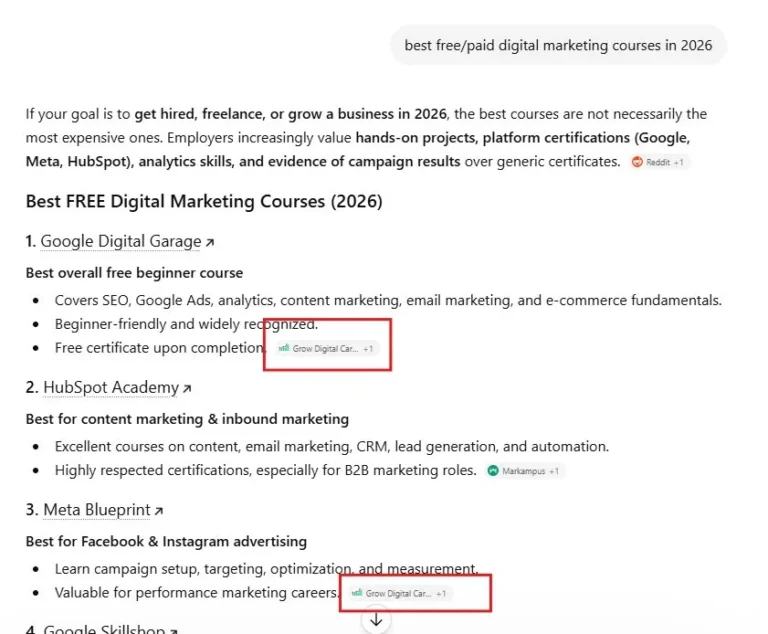
"best free/paid digital marketing courses in 2026" and prompt variations tested across sessions.
The Target Article
Newly published digital marketing career & course evaluation guide on Grow Digital Career.
Site State at the Time
Relatively new domain, limited backlink profile, zero paid outreach, but deeply cohesive niche topical cluster.
Speed to Citation
Cited in ChatGPT live retrieval within one week of publishing, across multiple answer instances.
The 6 Content Factors Behind the Citation
Extraction-Focused Structure
Clear heading hierarchy (H1-H3), comparison tables, bullet points, and answer passages placed right below headers.
Topical Cluster Depth
Surrounded by supporting content on skills, roadmap guides, and certification comparisons rather than isolated posts.
Schema Markup
FAQ and structured entity schema to provide unambiguous context signals for LLM web crawlers.
Concrete E-E-A-T Signals
Backed by verified practitioner experience (6+ years in digital marketing) and clear author bio credentials.
Intent-First Mapping
Addressed what course-seekers actually need to evaluate (cost, outcomes, syllabus depth) over keyword stuffing.
Tight Internal Interlinking
Created contextual links connecting beginner roadmaps directly to certification reviews and career playbooks.
The Result: ChatGPT Citation in Action
KEY TAKEAWAYS
AI visibility isn't identical to traditional rankings
Traditional Google SERPs prioritize accumulated domain authority, PageRank, and backlink velocity. ChatGPT's retrieval model prioritized clear passage answerability and entity clarity. A page that was not yet #1 on Google could still be selected as the best direct answer for an LLM synthesis.
Topical relevance & utility matter alongside authority
LLMs evaluate whether a passage directly resolves the user's implicit intent without fluff. Because the article was structured with direct comparison criteria, concise definitions under H2 tags, and clean bulleted summaries, the model's retrieval layer could easily extract it into a token stream.
AI visibility fluctuates over time
I got the citation. Later, the citation rotated out. AI search engines use dynamic reranking, live web cache refreshes, and probabilistic model outputs. Measuring AI visibility requires ongoing, repeated query testing across sessions, not celebrating a one-time win.
The Maturity of Experimental SEO
Anyone promising "Guaranteed #1 ChatGPT Citations" is misleading you. The true value of AI search optimization is structuring your entire content inventory so that whenever retrieval systems search your vertical, your content has the highest mathematical probability of being parsed and cited.
Want to build an AI & organic search strategy grounded in real testing?
We help B2B SaaS teams create structured, entity-rich content briefs that your existing writers can execute with confidence.