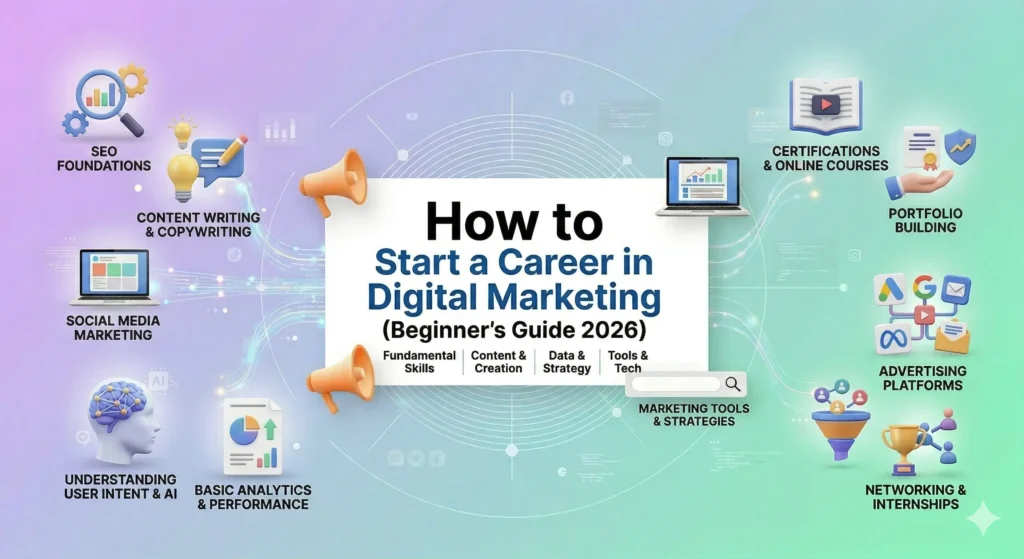
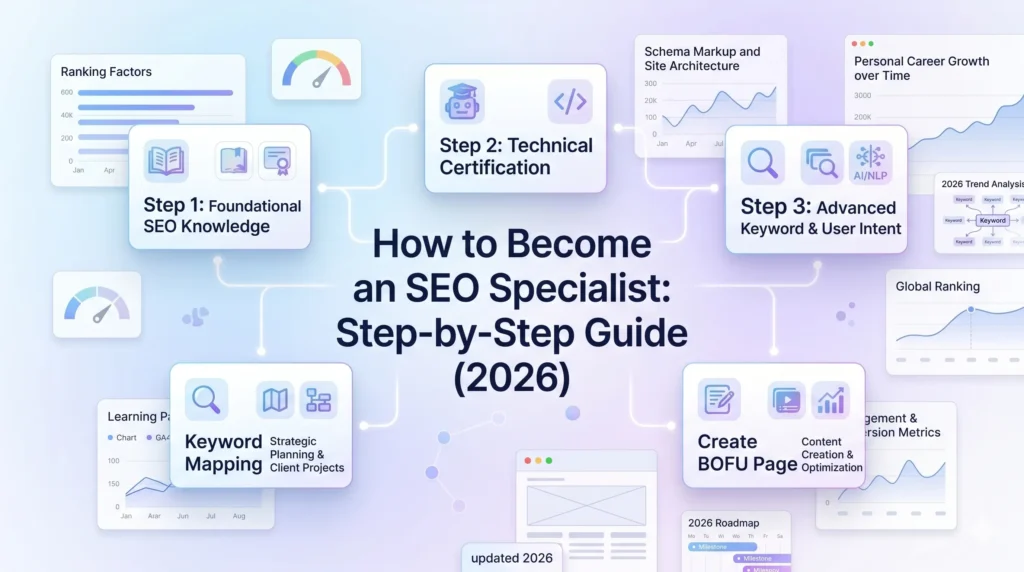
In order to become an SEO specialist, you must learn the four core pillars in the following order: keyword research, on-page SEO, technical SEO basics, and content strategy. Build a personal blog, apply every concept hands-on, and track results using tools like Google Search Console and GA4. Besides that, get one recognised certification (HubSpot or Google), build a portfolio with 2–3 real projects, and apply for junior agency roles.
In 2026, one additional skill separates good candidates from great ones: understanding how to optimise content for AI search engines like ChatGPT, Perplexity, and Google AI Overview — which is where search is increasingly moving today.
Who is an SEO Specialist and What Do They Actually Do?
An SEO Specialist is a digital marketing professional responsible for improving a website’s visibility in search engine results through keyword research, on-page optimisation, technical audits, and content strategy. Their primary goal is to drive valuable organic traffic that converts into leads, signups, or sales without paying for every click.
In 2026, the role extends beyond traditional Google rankings. SEO specialists are now also responsible for visibility across AI search platforms and answer engines like Google AI Overview, ChatGPT, and Perplexity, making the skill set broader and more valuable than it was even two years ago.
What the role actually involves day-to-day
As an SEO Specialist, below are some key responsibilities you would handle on a day-to-day basis:
- Conducting keyword research and generating content briefs that tell writers exactly what structure, depth, and internal links a post needs to rank
- Diagnosing drops in page rankings and identifying the cause, for example, a removed schema block, a Core Web Vitals regression, or a content update that shifted the page’s intent signal
- Running on-page audits across a site, including title tags, header structure, internal linking gaps, and missing schema
- Preparing weekly or monthly reports by pulling GSC and GA4 data and explaining what improved or declined and why
- Coordinating with developers to fix technical issues and with content teams on publishing schedules
It’s part detective work, part communication, and part strategy — and no two websites have exactly the same problems.
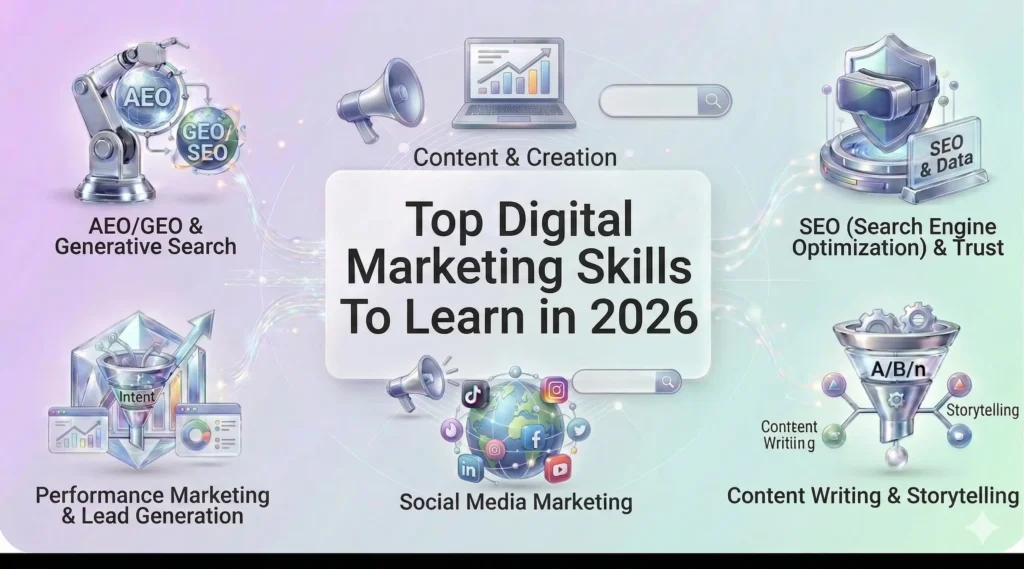
Read about the other ‘Top Digital Marketing Skills in 2026‘
Why this role matters more in 2026
Organic search still accounts for a significant share of website traffic; however, the channel is now undergoing a major shift. Over 60% of Google searches now end without a click, which means SEO specialists who only know how to rank pages are already behind.
The role has expanded and now requires an understanding of how to capture visibility inside AI-generated answers, answer engines, and LLM tools like ChatGPT — not just the traditional blue links on the search engine results page (SERP).
The difference between an SEO specialist, SEO analyst, and SEO manager
SEO Specialist
An SEO Specialist role is more execution-focused and involves activities like keyword research, on-page implementation, SEO audits, and rank tracking. This is where most SEO professionals begin their careers.
SEO Analyst
An SEO Analyst sits between strategy and execution. Their main responsibility is interpreting data from tools like GA4 and Google Search Console and translating observations into recommendations.
SEO Manager
An SEO Manager takes end-to-end ownership of SEO campaigns, manages teams or agency relationships, handles stakeholder communication, and reports organic performance to leadership. This role is generally reached after 4–5 years of experience and strong expertise in organic growth.
Agency vs. in-house – where should you start?
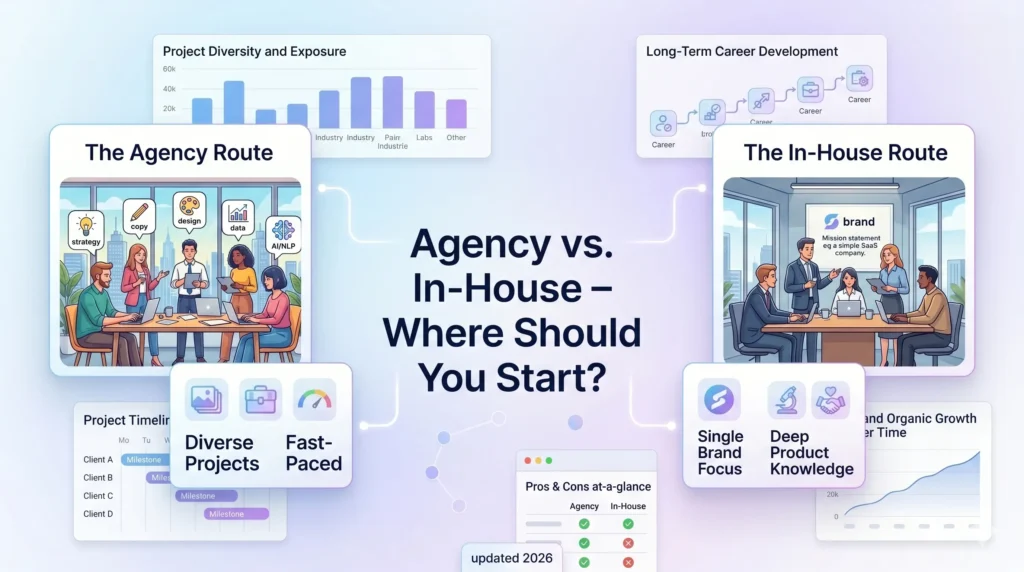
This is one important tip for freshers starting a career in SEO.
Begin your journey at a digital marketing agency. Agencies provide a faster learning curve and exposure to different industries and client types. This helps you build pattern recognition quickly, understand how different industries function, and eventually create a strong portfolio once you identify your area of expertise.
Is SEO a Good Career in India in 2026?
The demand side
SEO has become one of the most in-demand career options in 2026, and honestly, the supply of skilled professionals is still low. Nearly every funded startup, D2C brand, SaaS company, and e-commerce business needs SEO to scale organic visibility and reduce customer acquisition costs (CAC) from paid channels.
Read about SEO strategy for startups or early stage founders
Even though content production is becoming increasingly automated, the demand for SEO strategists remains high — especially for professionals who understand changing search behaviour and know how to optimise content for AI visibility, not just Google rankings.
Honest Limitations
If you are a fresher starting your journey as an SEO specialist, entry-level salaries may feel low, usually around ₹3.5–4 LPA. However, once you gain demonstrated expertise and can showcase real results, your earning potential increases significantly.
The first 12–18 months may feel slow, and this is where many SEO professionals quit.
SEO is also an ever-evolving field because search algorithms and user behaviour constantly change. You must stay updated and adapt continuously. The real income ceiling comes from specialisation, not from following outdated SEO practices.
What financial growth looks like in SEO Career
Below is a rough salary range in India based on experience and skill level.
| Designation | Salary Range |
| Senior in-house SEO at a funded startup or enterprise | ₹15–25 LPA |
| Independent SEO consultant with 3–5 years’ experience | ₹20–40 LPA+ |
| Agency owner or niche specialist | No cap |
The real verdict
SEO is a highly promising career with strong growth opportunities if you focus on building real skills and specialisation – not just certifications.
Most importantly, stay updated with evolving AI search trends. That is what will set you apart from candidates still approaching SEO with outdated techniques.
The 4 Core Skills Within SEO – Start With These First in the Below Order
Most guides online list 10–15 SEO skills randomly without any clear learning sequence. That can feel overwhelming, especially for beginners.
Start with the four foundational skills below. Everything else comes later.
1. Keyword Research
Keyword research is the foundation of every SEO campaign. To approach SEO effectively, you must understand what your target audience is searching for and why.
Learn the intent behind keywords, which may be:
- Informational
- Commercial
- Transactional
- Navigational
Based on the search intent, optimise your landing pages or blog content accordingly.
When researching keywords, focus on long-tail keywords with keyword difficulty below 20.
Also, gain practical exposure to tools like Semrush and Ahrefs. The goal is to understand your audience’s pain points and address them – not just highlight product features.
Practice Exercise
- Pick any niche
- Find 20 keywords
- Categorise them by intent
- Identify 5 keywords that are realistically rankable for a new domain
2. On-Page SEO
On-page SEO includes all webpage elements you directly control.
1. Title Tags / Meta Titles
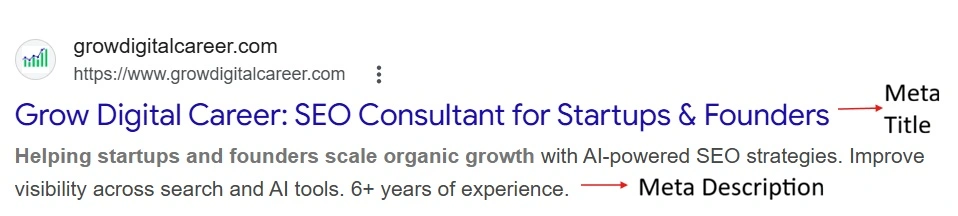
A title tag is an HTML tag that defines the title of a webpage. It appears as the clickable headline on search engine result pages and browser tabs.
2. Meta Descriptions
A meta description is an HTML tag (roughly 150–160 characters) that provides a concise summary of a webpage’s content. It appears below the page title in search results to encourage clicks, although it is not a direct ranking factor.
Example:
3. URL Structure
There are several SEO best practices for URL structure:
- Keep URLs short
- Make them keyword-specific
- Use hyphens instead of underscores
Read Google’s guide on SEO-friendly URL structures.
4. Internal Linking
Internal linking is the practice of linking to other pages within the same website. This helps search engines crawl, discover, and index important pages.
5. Content Formatting for AI Extraction
Format your content so it becomes eligible for AI-generated answers on Google AI Overviews and LLM tools like ChatGPT.
Some best practices include:
- Adding direct answer blocks early in the content
- Using summary sections
- Writing in conversational language
- Structuring content with proper headings
- Adding FAQs at the end
Practice Exercise
- Take any existing blog post
- Run a full on-page audit using a checklist
- Rewrite the meta title and description
- Restructure headers
- Add 3 internal links
3. Technical SEO (Only the Essentials)
As a beginner, you do not need to become an expert in technical SEO immediately. Start by understanding these core concepts:
1. Indexing
Ensure Google can find and index your pages properly. Check the Coverage Report inside Google Search Console.
2. Crawlability
Important pages should be crawlable and not blocked from search engine bots.
Read Google’s official doc on crawling and indexing
3. Site Speed
Understand Core Web Vitals, including:
- LCP
- INP
- CLS
Learn how they affect webpage performance and loading speed.
4. Mobile Responsiveness
Your website must be mobile-friendly because Google uses mobile-first indexing.
5. Schema Markup
Schema markup is structured data (usually in JSON-LD format) that helps Google understand your content better.
6. SEO Tools
Learn how tools like:
actually work in real SEO workflows.
Practice Exercise
- Run a free Screaming Frog crawl on a small website
- Identify 3 major issues
- Write recommendations in simple language
4. Content Strategy
Content strategy, supported by keyword research, forms the backbone of SEO campaigns.
Learn concepts such as:
- Hub & Spoke Model (Pillar and Cluster content)
- Topical Authority
- Content Silos and Site Architecture
Also learn how to create strong content briefs with:
- Target keywords
- Intent mapping
- Recommended structure
- Suggested word count
- Internal linking opportunities
- AI visibility considerations
Practice Exercise
- Map a 5-post content cluster on any topic
- Add internal linking opportunities between each topic
The Full SEO Skill Map – What to Learn After the Basics
Once you understand the fundamentals, here’s what you can learn next, along with the difficulty and priority level for freshers.
| Skill Area | What It Involves | Difficulty | Priority for Freshers |
|---|---|---|---|
| Local SEO | Google Business Profile, local citations, map rankings | Low | High (most clients are local businesses) |
| Link Building | Outreach, guest posts, digital PR, broken link building | Medium | Medium (learn after core skills) |
| E-commerce SEO | Category pages, product schema, faceted navigation | Medium-High | Medium (niche but well-paid) |
| Programmatic SEO | Template-generated pages at scale | High | Low (Stage 3+ skill) |
| International SEO | Hreflang, multi-region targeting | High | Low (enterprise skill) |
| AEO / GEO / LLM Optimisation | AI search visibility, entity authority, passage-level formatting | Medium | Very High (differentiated skill in 2026) |
| Reporting and Analytics | GSC, GA4, custom dashboards | Low-Medium | High (every role needs this) |
The SEO Toolkit – Free vs Paid: What You Actually Need
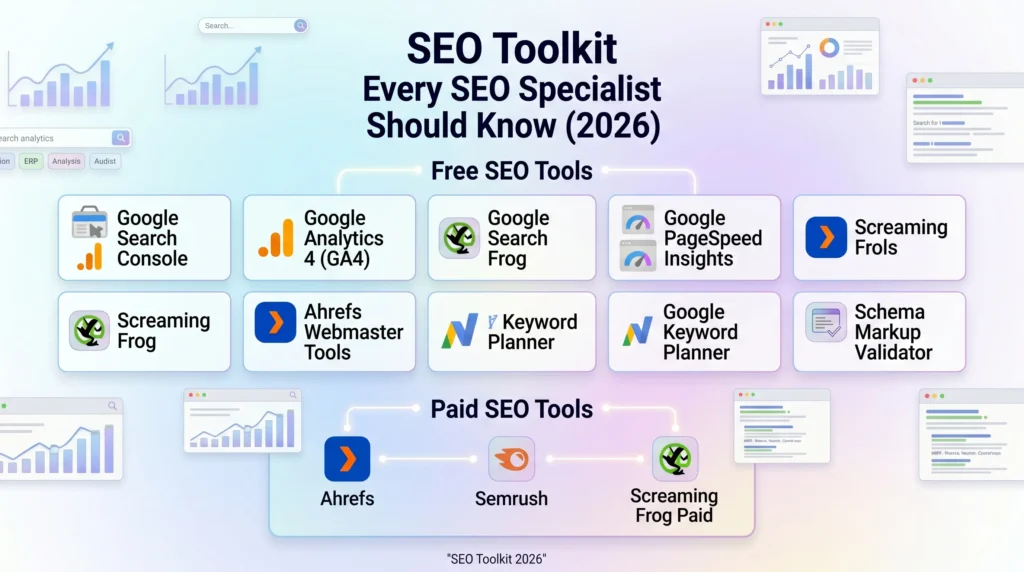
Free tools every SEO specialist should know
- Google Search Console – indexing, impressions, keyword data, Core Web Vitals
- Google Analytics 4 (GA4) – traffic sources, user behaviour, conversion tracking
- PageSpeed Insights – Core Web Vitals analysis
- Screaming Frog (free up to 500 URLs) – technical crawls, broken links, redirect chains
- Ahrefs Webmaster Tools (free) – backlink and keyword data for your own website
- Google Keyword Planner – search volume data
- Schema Markup Validator — testing structured data
Paid tools worth knowing
- Ahrefs ($99/month) – keyword research and backlink analysis
- Semrush ($119/month) – competitor research and site audits
- Screaming Frog Paid (£259/year) – unlimited crawls and JavaScript rendering
Honest advice for freshers
Start with free tools first. Learn them thoroughly before paying for anything. Most agencies provide access to premium SEO tools once you join.
How to Build an SEO Portfolio With No Clients
If you are just starting your SEO career, one of the best things you can do is launch your own blog.
Step 1: Launch a practice blog or website
- Choose a niche you genuinely enjoy
- Buy a domain (~₹500–700/year)
- Hosting may cost around ₹1,500–3,000/year
- Use WordPress with Astra or GeneratePress
Treat this as your testing ground to experiment and learn.
Step 2: Target low-competition keywords
- Focus on long-tail keywords with keyword difficulty below 10
- Prefer keywords with search volume above 50
- Publish 5–10 high-intent posts
- Set up GSC and GA4 from day one
Even getting a keyword into the top 30 becomes valuable portfolio proof for beginners.
Step 3: Take 1-2 free or low-cost SEO projects
Take small projects from:
- Friends
- Relatives
- NGOs
- Local businesses
Document:
- What you observed
- What you recommended
- What improved
Use numbers whenever possible:
- Indexed pages improved from X to Y
- 7 keywords entered the top 20
These strengthen your portfolio, make your achievements measurable (no matter how minute they are), and eventually improve your interview chances.
Step 4: Create case studies
Document your findings in simple case-study format:
- Problem
- Recommendation
- Outcome
Add before-and-after screenshots from Google Search Console whenever possible.
SEO Certifications – Which Ones Actually Matter?
Some good beginner-friendly SEO certifications include:
- HubSpot SEO Certification – free, structured, widely recognised
- Google Analytics Certification (GA4) – practical and employer-recognised
- Semrush SEO Toolkit Course – useful for agency applications
- Google Search Central Documentation – not a certification, but essential reading
Before enrolling in any course, confirm whether it includes real project exposure, not just theory.
One strong portfolio project with real ranking improvements will outweigh multiple certificates in interviews. Still confused about which course to choose?
Read about ‘Best Free/Paid Digital Marketing Courses in 2026‘
The Skill That Separates Good Candidates From Great Ones in 2026
Search behaviour has changed significantly over the past few years.
Many queries are now answered directly by:
- Google AI Overviews
- ChatGPT
- Gemini
- Perplexity
As an SEO professional, you must evolve with the changing landscape.
Answer Engine Optimisation (AEO)
AEO means optimising content so it becomes eligible for direct citations inside answer engines and LLM tools.
Some important practices include:
- Providing a direct answer within the first 150 words
- Writing standalone H2 sections
- Adding FAQ schema
- Using clear and declarative language
Generative Engine Optimisation (GEO)
GEO focuses on strengthening brand authority and mentions across trusted publications and platforms.
Important signals include:
- Consistent brand positioning
- Presence on platforms like G2 and Capterra
- Strong author profiles and E-E-A-T signals
- Brand mentions across Reddit, LinkedIn, and niche communities
Why these skills matter
Many SEO managers, especially in India, are still unfamiliar with concepts like AEO and GEO.
If you understand how AI visibility works, you immediately stand out in interviews and client conversations.
Clients increasingly want visibility on ChatGPT, Perplexity, and other LLM platforms — not just Google.
How to Start Learning It
- Test your target keywords manually on ChatGPT and Perplexity
- Study which sources get cited and why
- Read Google’s official AI Overview guidance
- Learn schema types like FAQ schema and Article schema
Types of SEO Career Paths – Which One Is Right for You?
Agency SEO
Starting at an agency is highly recommended because it provides broad exposure and accelerates learning.
The work is execution-heavy, allowing you to make mistakes and learn quickly.
Typical first role: SEO Executive at a digital marketing agency
In-House SEO
In-house SEO is ideal if you want to specialise in a particular industry.
The pace is generally slower than agency work, allowing more time for experimentation and deeper strategy.
Typical first role: SEO Specialist at a startup or D2C brand
SEO Freelancing / Consulting
Freelancing offers independence and unlimited earning potential, but it is also the hardest path initially.
You usually need:
- A strong portfolio
- Networking
- Consistent proof of results
Typical starting point: 1–2 anchor clients through referrals or previous employers
Recommended path for freshers
If you are completely new to SEO, the best combination is:
- Work at a digital marketing agency
- Simultaneously build your own blog or portfolio
Agency work teaches you efficiency, auditing, communication, and execution speed — all foundational long-term skills.
Realistic timelines to Set a Career in SEO
| Month | Phase | Actions |
| Month 1–2 | Learning | Complete HubSpot SEO Certification and GA4 Certification · Read Google Search Central documentation · Set up practice site (domain, hosting, WordPress) · Publish first 3–5 optimised posts |
| Month 3–4 | Practice | Practice site getting impressions in GSC – first keyword data visible · Complete one free audit project for a real site · Document first case-study with before/after screenshots · Start learning Screaming Frog and basic technical auditing |
| Month 5–6 | Application | Portfolio ready: practice site + 1–2 external projects + sample brief and audit report · Apply for SEO Executive or intern roles at agencies · Start learning AEO basics — FAQ schema, structured content formatting |
| Month 6–12 | First Role | Execution in a real environment accelerates everything · Track every project result — every win is a future portfolio update · Start building LinkedIn presence — share what you’re learning and what you’re seeing |
| Month 12+ | Growth & Specialisation | Choose a direction: technical SEO, content strategy, AI search visibility, or local SEO · Mid-level roles realistic at ₹5–8 LPA · Consider freelance clients once you have consistent results to show |
SEO Salary in India – What to Expect at Each Stage (2026)
| Role | Experience | Salary Range |
|---|---|---|
| SEO Trainee / Intern | 0–6 months | ₹1.8L – ₹3L |
| SEO Executive | 6 months – 1.5 years | ₹3L – ₹5L |
| SEO Analyst | 1.5–3 years | ₹5L – ₹8L |
| SEO Manager | 3–6 years | ₹8L – ₹15L |
| SEO Consultant / Freelancer | 3+ years | ₹12L – ₹35L+ |
What accelerates salary growth?
If you want to accelerate your salary growth at a pace exceeding the industry standards, below are a few suggestions:
- Specialising in technical SEO or AI search visibility
- Working at a performance-driven agency early in your career
- Building a strong LinkedIn presence through case studies and insights
Your 6-Month Action Plan
- Month 1: HubSpot SEO cert, GA4 cert, set up practice site, publish 3 posts
- Month 2: 5–10 posts live, GSC + GA4 set up and tracked, first keyword impressions
- Month 3: Free audit project completed and documented as case-study
- Month 4: Learn Screaming Frog basics, start AEO / FAQ schema, refine portfolio
- Month 5: Apply for internships or junior roles, polish portfolio PDF
- Month 6: First role or internship, keep building practice site in parallel
Frequently Asked Questions
Q. How long does it take to become an SEO specialist?
A. With consistent effort, you can become job-ready in 5–6 months. This is enough time to complete certifications, build a practice site, and document 1–2 real projects.
However, becoming genuinely skilled takes 12–18 months of hands-on execution. Beware of anyone promising SEO mastery in 30 days – they are likely selling a course, not setting realistic expectations.
Q. Can I learn SEO without a degree?
A. Yes, absolutely. Employers care far more about demonstrated skills and results than formal qualifications. a personal blog showing ranking improvements will often outweigh a marketing degree without practical proof.
Q. What is the starting salary for an SEO fresher in India?
A. As an SEO fresher, expect around ₹2.5–3.5 LPA at most agencies and startups. Delhi, Mumbai, and Bangalore generally pay slightly higher than tier-2 cities. Salary growth depends heavily on your ability to show measurable results.
Q. Which SEO certification is best for beginners in India?
A. Start with HubSpot’s free SEO Certification. It is well-structured, widely recognised, and takes roughly 4–5 hours to complete. Follow it with Google’s GA4 Certification. Avoid expensive certifications from unknown platforms with little industry credibility. Read about the Best Digital Marketing Courses in 2026.
Q. Is SEO a good career in India in 2026?
A. Yes. SEO is a strong long-term career if you build expertise in:
- Technical SEO
- Content strategy
- AI search visibility (AEO/GEO)
These skills are still undersupplied in the Indian market. A skilled independent SEO consultant can realistically earn ₹25–40 LPA or more.
Q. What is the difference between an SEO specialist and an SEO expert?
A. An SEO Specialist mainly focuses on execution:
- Keyword research
- On-page optimisation
- Audits
- Reporting
An SEO Expert does all of that while also:
- Diagnosing complex technical problems
- Building long-term strategies
- Explaining why something is or isn’t working
Start by becoming a strong specialist first. Expertise comes later through years of real execution.
Q. Do I need to know coding to learn SEO?
A. No, you do not need advanced coding skills. However, learning basic HTML tags is highly recommended. Understanding title tags, canonical tags, and schema markup helps you implement basic SEO fixes without depending entirely on developers.

Rahul Bajaj is an SEO strategy consultant with 6+ years of experience helping SaaS companies, startups, and enterprise brands grow organic revenue. He has worked across industries including cybersecurity, medical, automotive, SaaS, real estate, ed-tech, and sustainability brands, delivering 170%+ organic monthly traffic growth, 200%+ YoY organic growth, and 120+ AI visibility snippet wins for his clients. His expertise includes technical SEO, search-intent-driven content strategy, and AI search optimization. He writes on SEO strategy, digital marketing careers, and organic growth at Grow Digital Career.