
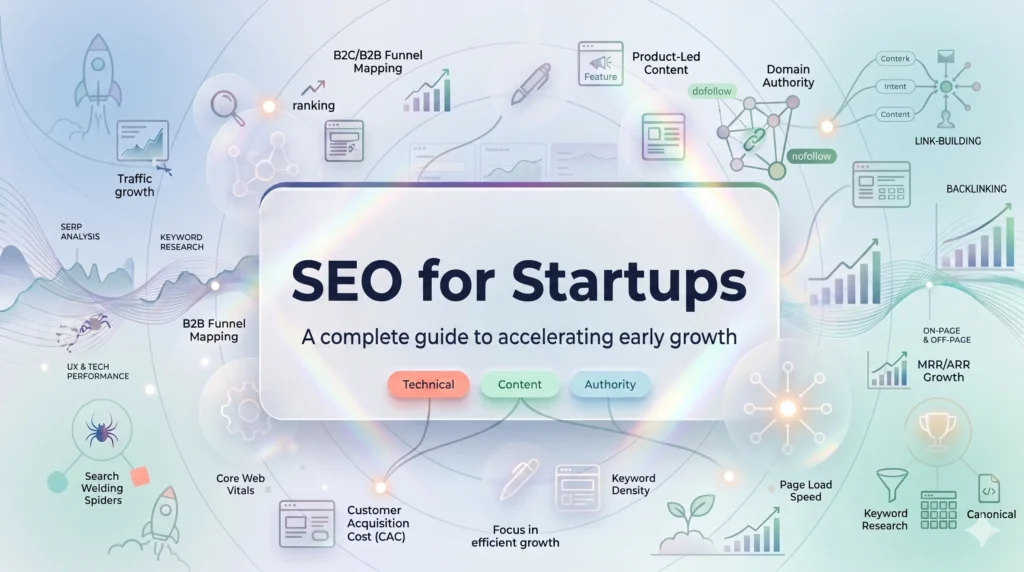
The first thing a startup must do for SEO is strengthen their website’s technical foundation, set up Search Console and analytics properly, ensure all the important pages are getting indexed, and host their blogs on the root domain. The second thing is identifying at least 10 BOFU (commercially driven) keywords. The rest, like building domain authority, programmatic SEO, and link outreach, comes at a much later stage.
Why Sequence or Steps Matter More Than Strategy at an Early Stage
Generally, when you read any SEO guide on this topic, you’ll come across a list of random to-do items, which probably have no connection to each other. What’s worse is that each item on that list would appear equally important, and you would not know where you must start.
Any founder or startup with very limited time on their hands might feel overwhelmed by this long list and might end up doing nothing, eventually concluding that SEO is not working. To address this problem, I’ve broken down the entire SEO strategy into a structured sequence, combining it with an explicit ‘ignore for now’ list. Because the honest truth is that 80% of your starting results come from 20% of the efforts, provided those efforts are aligned in the right direction.
Click here to read ‘How SEO Contributes to Business Revenue, not just website traffic.’
Do This First – The Non-Negotiable Technical SEO Foundation (Week 1)
Step 1: Confirm your site is actually indexable
Before you decide to move ahead with keyword research and publishing content on your website, first ensure the below non-negotiable checklist:
- Set up Google Search Console and Analytics (if you have not set them up already)
- Ensure that all the important pages within your website are getting crawled and indexed, such as the homepage, solutions, features, pricing, etc.
- Check that the robots.txt file isn’t blocking any important pages
Common mistake to avoid: Often, founders spend weeks or months on their content, only to realise later that their important pages are not even indexed by Google.
Step 2: Always host blogs on the main domain, not a subdomain
If your blog is hosted on a subdomain (e.g., blog.saas.com) and not on the main domain, it builds the authority of that subdomain, not your main website. This is surprisingly one of the most common and expensive SEO mistakes made by SaaS founders. What’s worse is that this issue remains invisible, and you won’t even realise its consequences unless you check. Hence, if you are a founder, always ensure that all your articles and blogs are hosted on the root domain of the website.
Step 3: Set up basic tracking
Monitoring and analysing your website performance is just as important as doing SEO itself.. This requires the proper setup of tools like Google Search Console so you can keep track of your top-performing pages and queries in terms of impressions, clicks, and position changes. Similarly, the GA4 dashboard has to be properly configured to track important metrics like sessions, active users, landing pages, conversion events, etc.
Step 4: Check Core Web Vitals Assessment across Desktop & Mobile Devices – Pass or Fail
To check the website performance/Core Web Vitals score across multiple devices, follow the below steps:
- Open Google PageSpeed Insights
- Enter your homepage URL and then one random blog post link
- Ensure you are passing the Core Web Vitals test on both desktop and mobile devices. Google would not rank a slow-loading page over a fast-loading one in a competitive space.
This is easy to check and is rather just a 20-minute activity for founders.
Do This Second – Research and Finalize 10 Keywords Before Writing a Word (Week 1–2)
The biggest mistake a founder or startup could make is publishing content based on what they think might be relevant for the industry. This is not entirely wrong; however, every piece of content going out on the website must be preceded or backed by solid keyword research. This is important because it validates the search volume for those keywords and maps your website content to what people are actually searching for on the internet to discover your products/solutions.
Click here to read about ‘SEO Roadmap for SaaS Startups.’
This is the reason why sufficient time must be spent researching keywords before publishing content.
Keyword Research Starter Process:
- List 3–5 use cases or problems that your product solves, and brainstorm how your target audience would search for them in their language, not the one you use to market the product.
- Open SEO tools like SEMrush or Ahrefs and enter those as seed keywords.
- Use a filter to segment keywords that fall below a keyword difficulty of 20 and have a search volume above 50.
- Analyse the top-ranking competitors for those keywords and identify the gaps.
- Finalize 10 keywords following the above steps, map each keyword to one unique page, and then stop.
Start with BOFU, not TOFU
As a priority, you must always target those keywords first that are commercially driven and have a high buying intent (comparison + alternatives) rather than broad informational queries. Anyone searching for “best project management software for remote teams” has a higher chance of converting than someone typing “What is project management?” As a founder, you would obviously want to rank for the former first.
The ‘ignore for now’ list of keywords
- Any keyword with a difficulty score above 40. These are highly competitive and difficult to rank for.
- Any keyword with a search volume less than 20.
- Head terms (these come into the picture once the website domain is 5 years old or more).
Do This Third – Publish Content in the Right Order (Week 2 Onwards)
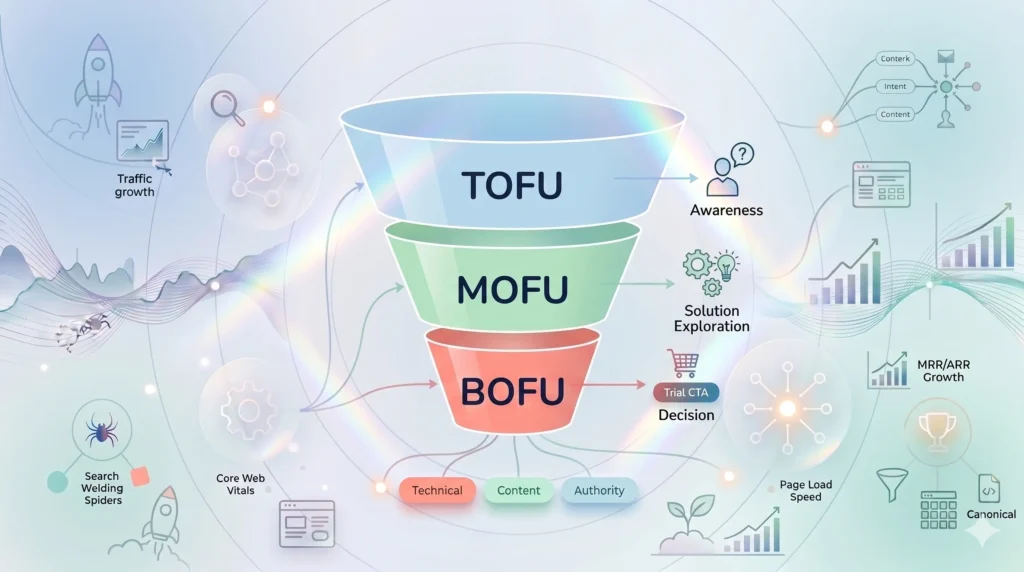
As a rule, never start writing with TOFU keywords. This is one of the biggest mistakes founders make because TOFU content is easier to write. Always follow the below publishing sequence:
First: BOFU pages (comparison + alternatives)
These pages have the highest chance of converting. Someone in the evaluation stage searching for “[Your tool] vs. competitors” is just days away from making a decision and is much lower in the marketing funnel.
Write more comparison guides and keep them structured. Include a feature table, a clear verdict, and a trial CTA, while keeping the tonality neutral and honest without sounding salesy. Even 800–1200 words would be sufficient if the content is well-structured and solves the user’s decision-making problem.
Second: MOFU guides (problem-first content)
Once you’ve published BOFU content, move towards those keywords or queries where people are looking for solutions to solve their problems. An example could be “how to manage sprint planning across time zones.” Such queries have much higher intent and are looking for content that helps them solve their problems. Writing content on this captures the right audience and introduces your tool naturally.
Target a word count of 1500 to 2000 words, where you mention the product as part of the solution, not as the primary focus.
Third: TOFU content (last)
This includes broad informational content that builds topical authority over time but rarely converts early. As a rule, start writing TOFU content only once you have 3–5 BOFU/MOFU pages live.
Internal linking from the start
- Every post must link back to your pillar page
- Every post must link to at least 2 other related posts
- Never publish an orphaned page – a post with no inbound internal links gets crawled slowly and builds authority slowly
Click here to learn about the Modern SEO strategy.
Metrics or Activities to Ignore (At Least for Now)
During the initial stages of your SEO campaigns, don’t focus on the below vanity metrics or indicators:
Domain Authority / DR scores
Domain authority builds over time and is not a metric that actually moves your needle. This is best ignored for at least 6 months once you start doing SEO.
Link Building Outreach
All link-building activities such as HARO, guest posting, and email outreach must be pursued only once you have a solid content base or repository. Focus on building the content first; links will follow.
Programmatic SEO
Template-generated pages at scale require domain authority, structured data, and development resources. On a 3-month-old domain, they produce thin pages that don’t rank.
Social Signals
Social media activities and engagement such as likes, shares, and comments complement SEO activities but don’t directly influence rankings. Distribute your content on social, but don’t mix it with SEO.
Weekly-ranking reports
During the initial phase, rankings are much more volatile and keep changing. Constantly checking your weekly reports could make you anxious and not provide any valuable insights in return. Don’t rely on weekly reports; check monthly performance instead.
Targeting your main category/primary keyword
If you start by targeting the most competitive primary keyword in your niche, you will only end up disappointed. Shift your focus to long-tail, less competitive keyword variations first. “Project management software” is already dominated by strong players like Asana, Monday.com, ClickUp, Notion, and Jira. You will not rank for this at Stage 1.
What “Working” Looks Like in the First 90 Days
One of the biggest reasons founders end up disappointed with SEO is not because of a lack of results but because of unrealistic expectations or incorrect metrics tracking.
Below is what success looks like in the first 90 days so you can ensure that you always check the right metrics:
- Month 1: Pages indexed, GSC showing impressions, zero meaningful rankings (this is normal)
- Month 2: Long-tail keywords entering the top 30–50 and the first trickle of organic traffic – SEO is working
- Month 3: Some keywords in the top 20 and the first organic sessions that look like real buyers – this is when it starts compounding
Metrics to check monthly, not weekly
Cut through the noise and only check the below metrics that actually matter:
- Total indexed pages in GSC
- Number of keywords with at least 1 impression
- Organic sessions in GA4
The One-Week SEO Action Plan for Founders
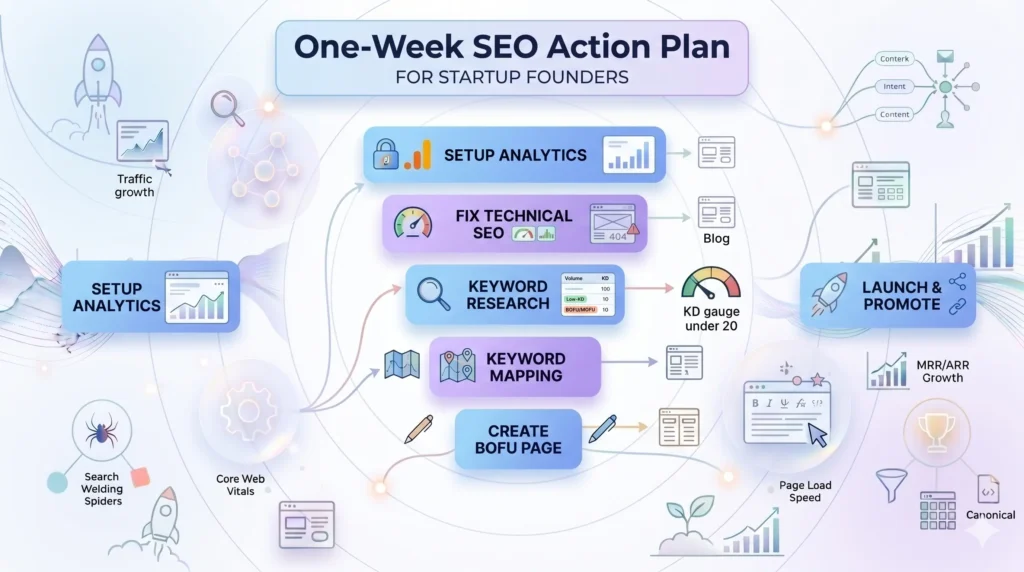
- Day 1: Set up GSC + GA4, verify indexing, check the robots.txt file
- Day 2: Fix the subdomain blog issue if present and run PageSpeed Insights
- Day 3–4: Run keyword research — find 10 BOFU/MOFU keywords with KD under 20
- Day 5: Map each keyword to a page — existing or new
- Day 6–7: Write or brief your first BOFU page (comparison or alternatives)
That’s enough to have a real SEO foundation in place.
Frequently Asked Questions
Q. What should a startup do first for SEO?
A. First of all, fix the technical foundation before anything else — confirm your pages are indexed in Google Search Console, ensure your blog is on your root domain (not a subdomain), and run a Core Web Vitals check. Once that’s done, identify 10 BOFU keywords. Content comes after, not before.
Q. How many keywords should a startup target initially?
A. Never exceed 10. One keyword should be mapped to one page, all with keyword difficulty under 20 and monthly volume above 50. Going broader than this at an early stage spreads effort across too many pages and builds authority on none of them.
Q. Is SEO worth it for pre-revenue startups?
A. Only if your positioning is stable. If you’re still testing who your customer is and what problem you’re solving, content built on the wrong messaging is wasted. Set up the technical foundation and identify your BOFU keywords, but hold off on scaling content until you have early signs of product-market fit.
Q. What’s the biggest SEO mistake early-stage startups make?
A. Publishing TOFU content first. Broad educational posts are easy to write and feel productive, but they attract the wrong audience and convert poorly. The founders who see early organic results are the ones who start with comparison and alternative pages — i.e., content that captures buyers who are already close to making a decision.
Q. How do I know if my startup SEO is working?
A. Keep track of only three metrics monthly: total indexed pages in GSC, number of keywords with at least one impression, and organic sessions in GA4. In Month 1, expect impressions but no traffic. In Month 2, expect long-tail keywords entering the top 30–50. In Month 3, expect the first trickle of real organic visitors. If those signals are moving in the right direction, SEO is working, even if it doesn’t feel like it yet.

Rahul Bajaj is an SEO strategy consultant with 6+ years of experience helping SaaS companies, startups, and enterprise brands grow organic revenue. He has worked across industries including cybersecurity, medical, automotive, SaaS, real estate, ed-tech, and sustainability brands, delivering 170%+ organic monthly traffic growth, 200%+ YoY organic growth, and 120+ AI visibility snippet wins for his clients. His expertise includes technical SEO, search-intent-driven content strategy, and AI search optimization. He writes on SEO strategy, digital marketing careers, and organic growth at Grow Digital Career.